Adhesives for motor magnet bonding shall be selected based on motor rotational speed, long‑term temperature resistance, magnet‑to‑rotor substrate combination, adhesive layer thickness, curing method and production cycle. For conventional one‑component heat‑curing options, evaluate Elaplus EP 1739‑1K. Choose EP 1769‑1K when high Tg and high thixotropy are required. For two‑component systems with high shear strength and toughness, select EP 2029‑2K. For high‑frequency electromagnetic fast curing requirements in small motors, EP 1772‑1K is recommended.
Why Mechanical Snap‑in Grooves Alone Are Not Enough for Motor Magnets
During operation, permanent‑magnet motor magnets are subjected to:
- Centrifugal force generated by high‑speed rotation
- Impact loads from motor start‑stop cycles
- Long‑term vibration
- Elevated temperatures from winding heat generation
- Thermal expansion mismatch among rotor, magnet and adhesive layer
- Erosion by cooling oil or other media
Adhesive failure may cause magnet displacement, detachment and rotor unbalance. In severe cases, the motor stator and housing can be damaged.
Recommended Grades for Conventional Magnet Bonding
EP 1739‑1K: One‑component semi‑fluid epoxy adhesive
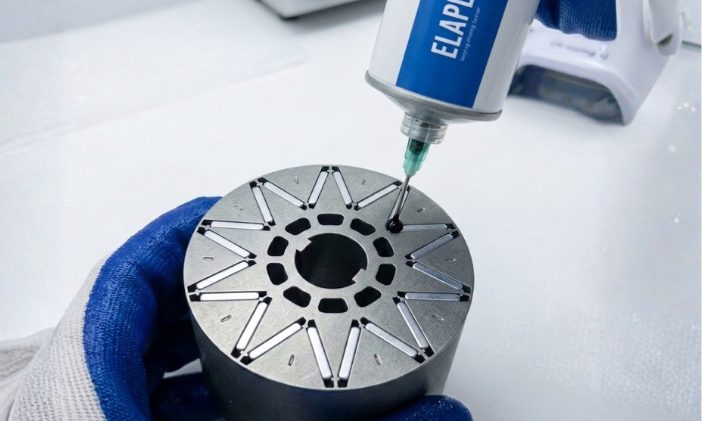
Motor Magnet Bonding
EP 1739‑1K is a one‑component heat‑curing epoxy adhesive with semi‑fluid consistency. Its datasheet lists viscosity at approx. 27 000 cps and service temperature ranging from ‑50 ℃ to 200 ℃.
Suitable for:
- Permanent‑magnet motor magnet bonding
- Bonding between magnet segments and metal rotors
- Bond grooves requiring adequate wetting and flowability
- Automated dispensing production lines for one‑component adhesives
EP 1769‑1K: High‑Tg & high‑thixotropy magnet‑bonding adhesive
EP 1769‑1K is a one‑component low‑flow epoxy adhesive with viscosity ≥ 300 000 cps. Recommended curing profile: 120 ℃ for 30 minutes; service temperature: ‑50 ℃ ~ 200 ℃.
Suitable for:
- Vertical‑face magnet bonding
- Rotors requiring stable adhesive bead geometry after dispensing
- High‑speed permanent‑magnet motors
- Motors demanding high‑Tg and high‑temperature retention performance
- Structures where no obvious sagging is permitted after automated dispensing
Recommended Two‑Component Magnet‑Bonding Grade
EP 2029‑2K: High‑shear epoxy structural adhesive
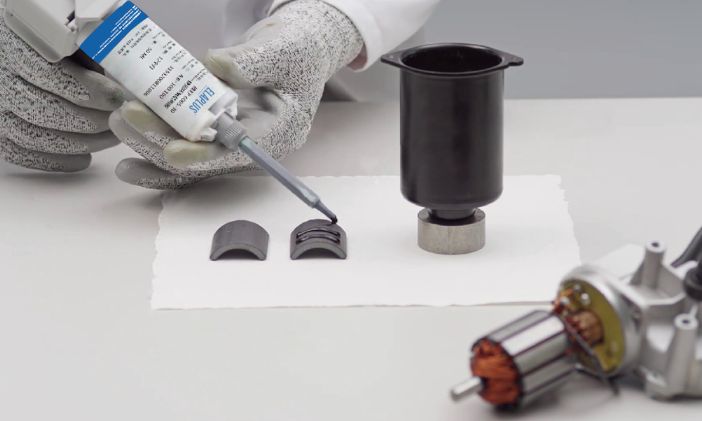
Motor Epoxy Structural Adhesive
EP 2029‑2K is a 2:1 two‑component epoxy adhesive featuring good peel resistance and shear strength. According to its datasheet, shear strength on stainless steel reaches approx. 6 MPa at 150 ℃; service temperature ranges from ‑50 ℃ to 180 ℃.
Suitable for:
- Permanent‑magnet synchronous motors
- Servo motors
- Robot joint motors
- Structural bonding between magnets and metal rotors
- Applications requiring balanced shear strength and moderate toughness
Grade for High‑Volume Small‑Motor Production
EP 1772‑1K: High‑frequency electromagnetic fast‑curing adhesive
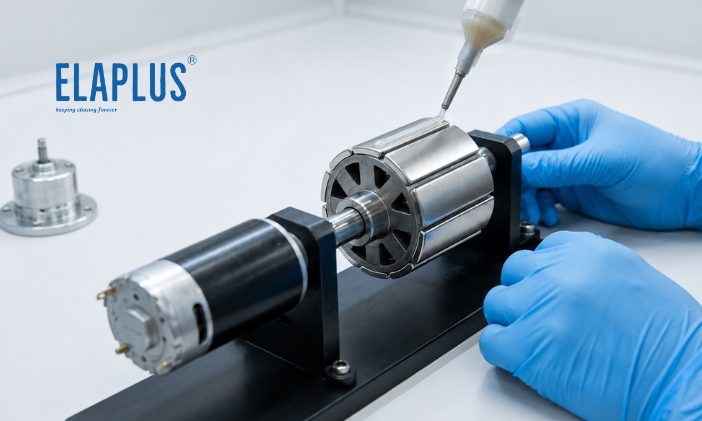
EP 1772‑1K is a one‑component epoxy adhesive that achieves fast curing within around 20 seconds via high‑frequency electromagnetic heating, ideal for magnet segment bonding of small‑size motors.
Recommended applications:
- Micro DC motors
- Small brushless motors
- Power‑tool motors
- Household appliance motors
- Magnet‑segment assembly lines with strict takt‑time requirements
Elaplus EP 1739‑1K, EP 1769‑1K, EP 2029‑2K and EP 1772‑1K cover semi‑fluid thermal curing, high‑thixotropy high‑Tg, two‑component high‑shear and high‑frequency fast‑curing processes for motor magnet bonding solutions.
Motor Magnet‑Bonding Adhesive Grade Comparison
| Grade | Curing Method | Key Features | Suitable Motors |
|---|---|---|---|
| EP 1739‑1K | Heat curing | Semi‑fluid, good wetting property | General‑purpose permanent‑magnet motors |
| EP 1769‑1K | Thermal curing @120 ℃ | High Tg, high thixotropy | High‑speed motors |
| EP 2029‑2K | Two‑component curing | High shear strength, favorable peel resistance | Servo motors, robot motors, drive motors |
| EP 1772‑1K | High‑frequency electromagnetic curing | Fast curing in ~20 s | Small‑size motors |
FAQ on Motor Magnet‑Bonding Adhesives
Is higher shear strength always better for magnet‑bonding adhesives?
Room‑temperature shear strength alone is insufficient. High‑temperature shear performance, thermal cycling resistance, vibration resistance and strength retention after media aging must also be verified.
Is surface pretreatment required before magnet bonding?
Oil, rust inhibitors, dust and oxides on magnet and metal rotor surfaces shall be thoroughly removed.
How to choose between one‑component and two‑component magnet‑bonding adhesives?
One‑component grades fit automated dispensing and uniform oven curing. Two‑component grades reduce reliance on high‑temperature curing but demand precise metering and mixing.
Elaplus Functional Materials (Shanghai) Co., Ltd.
Technical selection & free sample request: +86‑21‑67227200
E‑mail: info@elaplus.cc
Website: www.elaplus.cc
Address: No.555 Jiugong Road, Jinshan Industrial Zone, Shanghai, China