When selecting potting materials for server power supplies, thermal conductivity alone should not be the sole consideration.
With the continuous increase in power density of AI servers, power supply modules, high‑frequency transformers, inductors, PFC and DC‑DC modules are subjected to rising temperature rise, vibration and electrical stress. A suitable potting material must strike a balance among thermal conductivity, electrical insulation, stress resistance, flame retardancy, flowability and production cycle time.
Improper material selection may lead to incomplete filling, excessive bubbles, cracking upon curing, component stress‑induced damage and unstable heat dissipation performance.
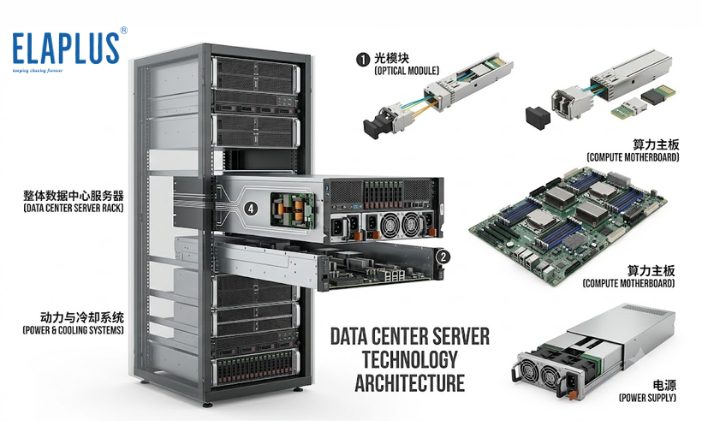
1. Why Do Server Power Supplies Require Potting?
Server power supplies integrate a large number of power devices and magnetic components, operating continuously under high‑load, frequent start‑stop and persistent heat‑generation conditions.
Potting materials generally deliver the following functions:
- Fill air gaps between transformers, inductors and housings;
- Facilitate heat transfer to metal enclosures or heat‑dissipation structures;
- Secure windings, magnetic cores and pins to reduce vibration and noise;
- Improve insulation, moisture resistance and anti‑contamination performance;
- Alleviate mechanical stress caused by transportation, fan vibration and thermal cycling;
- Lower risks of partial discharge, creepage and loose wiring.
It should be noted that potting does not mean fully filling the entire power‑supply module.
High‑frequency transformers, inductors and auxiliary power supplies are suitable for potting. Between power semiconductors and heat sinks, thermal gels, thermal greases or other thermal interface materials are more applicable.
2. Do Not Rely Solely on Thermal Conductivity for Material Selection
2.1 Actual Thermal Resistance Outweighs Nominal Thermal Conductivity
High nominal thermal conductivity does not guarantee superior practical heat dissipation.
Whether a stable thermal conduction path can be formed after potting depends on multiple factors:
- Adhesive layer thickness;
- Clearance between components and housing;
- Material wetting performance on coils and magnetic cores;
- Internal bubbles and voids;
- Interfacial contact after curing;
- Cracking and delamination after long‑term thermal cycling.
For server power supplies, temperature‑rise tests on actual modules are recommended, instead of merely comparing W/m·K values from product datasheets.
2.2 Flowability Determines Potting Feasibility
Fine winding gaps commonly exist inside high‑frequency transformers and inductors. Excessively high material viscosity prevents sufficient penetration into gaps among coils, bobbins and magnetic cores, resulting in bubbles or unfilled areas.
Therefore, key points to verify during selection:
- Viscosity after mixing;
- Pot life;
- Vacuum degassing requirements;
- Potting speed and dispensing path;
- Necessity of component preheating;
- Curing exotherm for thick‑layer potting.
High‑thermal‑conductivity materials contain abundant thermal fillers. Higher thermal conductivity is usually accompanied by increased viscosity and density. A balance between thermal performance and processability shall be achieved in material selection.
3. Epoxy, Silicone or Polyurethane: How to Choose
| Material System | Key Features | Target Applications |
|---|---|---|
| Epoxy Potting Compound | High strength, good adhesion, excellent insulation and robust structural fixation | Transformers, inductors, magnetic components and applications requiring high‑strength fixation |
| Silicone Potting Compound | Flexible, low‑stress, wide‑temperature resistance, great thermal‑cycling tolerance | Large‑size power‑supply modules, stress‑sensitive components and thermal‑cycling‑intensive scenarios |
| Polyurethane Potting Compound | Balanced flexibility, adhesion and cost | Control boards, auxiliary power supplies and general‑purpose electronic modules |
Epoxy System: Prioritize Fixation and Structural Strength
Cured epoxy potting compounds feature high hardness, which firmly secures windings, magnetic cores and pins. They are ideal for magnetic components in server power supplies demanding high vibration resistance, insulation and structural stability.
Nevertheless, epoxy systems exhibit high modulus. For large‑scale potting or structures under drastic temperature variation, CTE, curing shrinkage and thermal‑cycling cracking risks shall be thoroughly evaluated.
Elaplus EP 1715 is a two‑component solvent‑free thermally conductive epoxy potting compound with a thermal conductivity of approximately 1.5 W/m·K. It delivers low CTE, high hardness and outstanding electrical insulation, suited for high‑power‑density magnetic components and power modules requiring both thermal conduction and mechanical fixation.
Silicone System: Prioritize Low Stress and Thermal‑Cycling Resistance
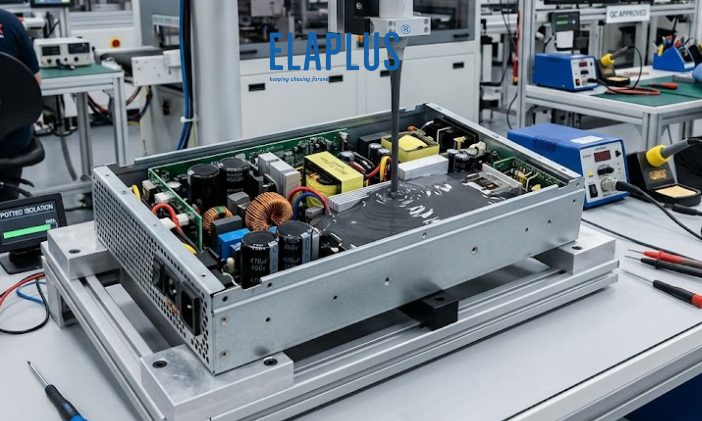
Cured silicone materials remain relatively flexible, buffering thermal‑expansion mismatches among electronic components, metal housings and potting compounds. They are better suited for large‑size power‑supply modules with prominent temperature fluctuation or stress‑sensitive devices.
Elaplus SIPA 1850 is a two‑component thermally conductive silicone potting compound with a 1:1 mixing ratio. Multiple thermal‑conductivity grades are available for diverse application requirements. It applies to thermal‑conductive potting for server power supplies, transformers, inductors, controllers and other power‑electronic modules.
4. Additional Key Indicators for Server‑Power‑Supply Potting
Flame Retardancy and Electrical Insulation
Server power supplies work under long‑term high‑voltage and high‑current conditions. Evaluate materials against whole‑machine requirements on:
- UL94 flame‑retardant rating;
- Dielectric strength;
- Volume resistivity;
- Comparative tracking index;
- Water absorption rate;
- Insulation stability under high‑temperature‑high‑humidity conditions.
Do not only reference initial insulation data; verify performance variations after damp‑heat aging and thermal cycling.
Curing‑Induced Stress and Thermal Expansion
Transformers consist of copper wires, magnetic cores, plastic bobbins and metal housings with vastly different coefficients of thermal expansion.
Over‑hard or high‑shrinkage potting materials may trigger:
- Magnetic‑core stress damage;
- Cracks on solder joints and pins;
- Deformation of plastic bobbins;
- Delamination between compound and housing interfaces;
- Cracks generated after thermal cycling.
For large‑size, thick‑layer potting, pay close attention to material modulus, CTE, curing temperature and exothermic peak value.
Process Cycle Time and Batch Consistency
For mass‑volume manufacturing of server power supplies, materials must adapt to automated production:
- Ease‑of‑mixing for Part A and Part B;
- Tolerance for mixing‑ratio deviation;
- Pot‑life matching dispensing tact time;
- Curing time impact on production capacity;
- Sedimentation risk of thermal fillers;
- Viscosity stability during continuous production;
- Convenience of equipment cleaning and maintenance.
A material with excellent lab‑level performance yet poor dispensing stability cannot be deployed in mass production.
5. Site‑Specific Material Selection
High‑Frequency Transformers & Inductors
Key concerns: thermal conductivity, insulation, wetting performance, low void rate, vibration resistance and temperature rating.
Evaluate thermally conductive potting systems such as SIPA 1850 or EP 1715 according to stress and structural requirements.
Power Devices & Heat Sinks
Standard potting compounds are generally not recommended to replace thermal interface materials for this position.
Prioritize interfacial thermal resistance, bond‑line thickness, compressibility, long‑term pump‑out effect and rework requirements. Elaplus TCMP 3380 and other thermal‑interface‑material products can be considered.
Control Boards & Auxiliary Power Supplies
Adopt partial potting or conformal‑coating solutions based on moisture‑proof, insulation, flame‑retardant and stress requirements. For PCB surface protection, UV/moisture dual‑cure conformal coatings such as COATING 9060 UV are applicable.
Terminals, Pins & Wire‑Harness Roots
Focus on insulation reinforcement, vibration‑resistant fixation and stress transition. Avoid excessive encapsulation of positions requiring heat dissipation, testing or rework; prevent new harness fatigue points formed by hard‑adhesive edges.
6. Elaplus Material Solutions for Server Power Supplies
After preliminary screening of potting materials for server power supplies, prototype verification shall be performed according to component dimensions, potting depth, operating temperature and production tact time.
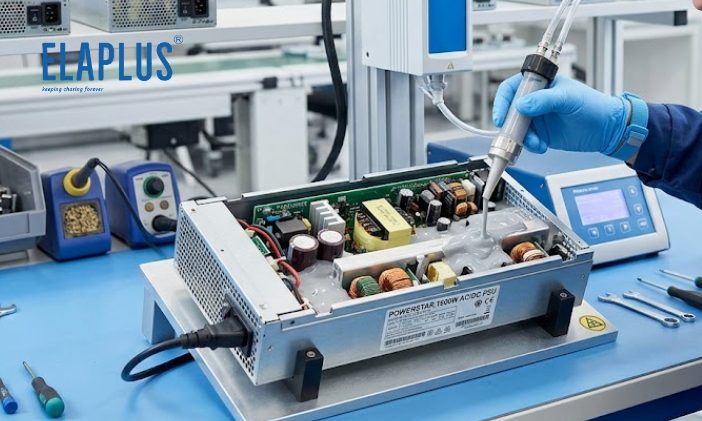
Elaplus provides diversified material solutions for server power supplies, high‑frequency transformers, inductors, power modules and control boards.
SIPA 1850 Thermally Conductive Silicone Potting Compound
Two‑component thermally conductive silicone potting compound with 1:1 mixing ratio, UL94 V‑0 flame retardancy, and multiple optional thermal‑conductivity grades.
Suitable for scenarios requiring:
- Low‑stress performance;
- Wide‑temperature‑range adaptability;
- Thermal conduction for power modules;
- Potting for transformers and inductors;
- Protection for server power supplies and controllers.
EP 1715 Thermally Conductive Epoxy Potting Compound
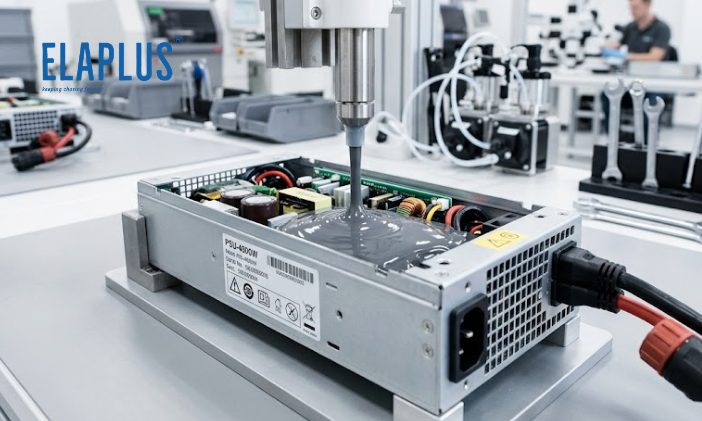
Two‑component solvent‑free thermally conductive epoxy potting compound, thermal conductivity ~1.5 W/m·K, Tg 95‑105 ℃. Features low CTE, high hardness and superior electrical insulation.
Its dielectric strength exceeds 18 kV/mm. It is applied to magnetic components and power‑electronic modules demanding combined thermal conduction, insulation, structural fixation and thermal‑cycling resistance.
TCMP 3380 Thermal Interface Material
Compressible down to approximately 250 μm with certain reworkability. Used for thin‑layer thermal interfaces between power devices/chips and heat sinks.
This product targets contact thermal resistance between power devices and heat‑dissipation structures; it shall not be used as bulk potting compound for magnetic components.
COATING 9060 UV Conformal Coating
UV/moisture dual‑cure PCB conformal coating, viscosity 800‑1200 mPa·s. UV‑exposed areas achieve fast initial curing; shadow‑zone and deep‑section areas complete secondary curing via moisture.
Suited for moisture‑proof, anti‑corrosion and insulation protection for control boards, driver boards and auxiliary‑power‑supply boards of server power supplies.
7. Validation Items for Server‑Power‑Supply Potting Materials before Mass Production
Prior to formal mass production, complete at least the following tests:
- Temperature‑rise test on actual modules;
- Thermal‑cycling test;
- High‑temperature‑high‑humidity test;
- Vibration and mechanical‑shock test;
- Dielectric‑strength and insulation‑resistance test;
- Flame‑retardant test;
- Inspection for curing cracking and interfacial delamination;
- Long‑term thermal‑aging test;
- Automated‑dispensing stability test;
- Inspection for potting voids and wetting quality.
The suitability of server‑power‑supply potting compounds shall be finally judged by real‑module test results covering temperature rise, insulation, stress performance and process compatibility.
FAQ
Q: Is higher thermal conductivity always better for server‑power‑supply potting compounds?
A: No. Increased thermal conductivity is usually accompanied by changes in viscosity, density and hardness. Server‑power‑supply potting materials must comprehensively consider flowability, bond‑line thickness, bubble formation, curing‑induced stress and practical interfacial thermal resistance.
Q: Epoxy or silicone potting compound for high‑frequency transformers?
A: It depends on structural and stress requirements. Thermally conductive epoxy is preferred when high‑strength fixation, vibration resistance and sound adhesion are demanded. Thermally conductive silicone is recommended for large‑size structures, severe thermal cycling or stress‑sensitive components.
Q: Can server power supplies be fully potted?
A: Indiscriminate full potting is not advised. Magnetic components such as high‑frequency transformers and inductors are suitable for potting; thermal gels or thermal interface materials are normally adopted between power devices and heat sinks.
Q: Are flame‑retardant properties required for server‑power‑supply potting compounds?
A: Flame retardancy is required for most server‑power‑supply applications. The exact rating shall be confirmed against whole‑machine design, potting thickness, customer specifications and certification requirements.
Q: How to reduce bubbles in server‑power‑supply potting?
A: Mitigate bubbles and voids by optimizing dispensing paths, controlling mixing viscosity, applying vacuum degassing, preheating components, limiting single‑layer potting thickness and extending levelling time.
Conclusion
Against the backdrop of rising server power density, potting materials for power supplies must address heat dissipation, insulation, vibration resistance, flame retardancy and thermal‑stress‑related challenges simultaneously.
The ideal server‑power‑supply potting compound is not necessarily the one with the highest thermal conductivity, but the material that strikes a fine balance among thermal‑dissipation efficiency, component stress, potting process and long‑term reliability.
Elaplus delivers material‑selection support for thermally conductive potting, conformal‑coating protection and thermal‑interface‑material solutions, customized according to server‑power‑supply component structure, potting depth, operating temperature, thermal‑conductivity requirements and manufacturing processes.
Original Manufacturer|Technical Selection Support|Free Sample Available
📩 info@elaplus.cc