As humanoid robots enter a phase of rapid development, frameless torque motors—the core drive components—act as the “muscle system” of robot joints.
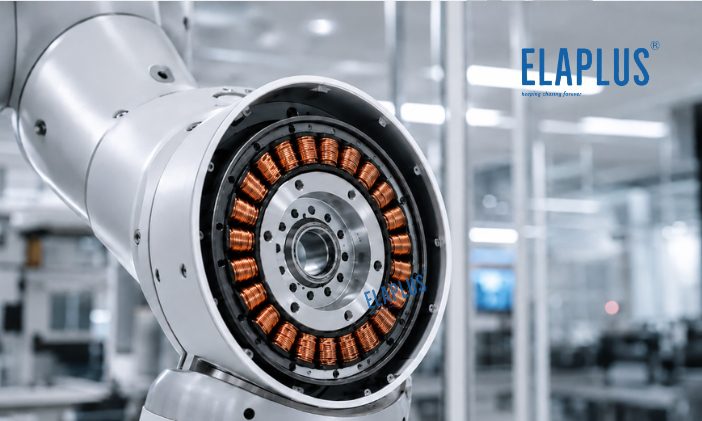
However, numerous engineers repeatedly highlight a critical challenge in practical engineering design:
Motor stators generate severe heat within an extremely compact structural space. How to simultaneously resolve heat conduction, electrical insulation and crack resistance issues?
The solution lies in one core material:
■ EP 1716 High Thermally Conductive Epoxy Potting Compound
Why Potting Is Mandatory for Frameless Torque Motors
The structural characteristics of frameless torque motors make potting materials indispensable:
■ High torque density → concentrated heat generation
■ No housing air cooling → poor heat dissipation
■ Compact construction → short heat transfer paths
■ Long-term operation under low speed and high torque
Without potting treatment, the following failures will typically occur:
■ Excessive temperature rise of stators
■ Degraded insulation performance
■ Vibration abrasion of windings
■ Failure caused by long-term thermal aging
■ Unstable joint drive performance
Therefore, potting material is far more than just a filler; it serves as the core material integrating motor thermal management, structural fixation and electrical insulation.
Why Epoxy Is the Optimal Choice
Potting for torque motor stators needs to satisfy three key requirements simultaneously:
■ Thermal conductivity
■ Structural bonding strength
■ Resistance to thermal cycling
Comparison of three mainstream material systems:
■ Silicone: Soft but weak bonding strength, high coefficient of thermal expansion (CTE)
■ Polyurethane: Good toughness but limited temperature resistance
■ Epoxy: High mechanical strength, outstanding stability and reliable structural locking
Conclusion: Only epoxy can deliver long-term stable structural fixation.
Core Advantages of EP 1716
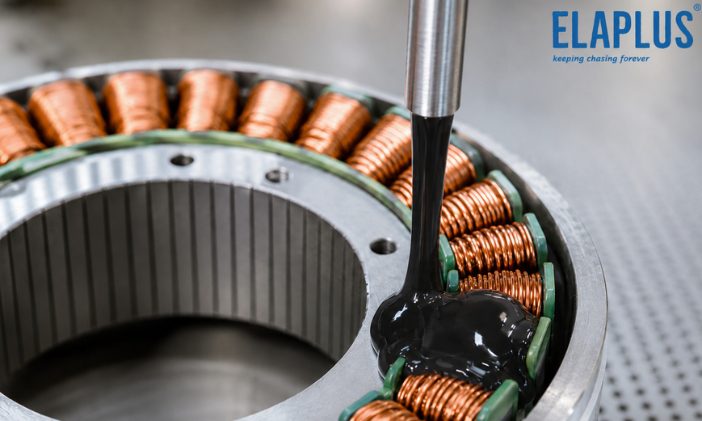
■ High thermal conductivity: Thermal conductivity coefficient of 1.5 W/mK, efficiently transferring heat from windings to the housing and unlocking continuous torque output potential;
■ Low CTE: Linear expansion coefficient of only 25 μm/m·℃ below Tg, paired with excellent crack resistance to withstand repeated thermal cycling;
■ High temperature resistance: Long-term service temperature range of −50℃ to 180℃, with a Tg of 95~105℃, suitable for prolonged high-load operation;
■ Strong adhesion & high hardness: Shear strength ≥10 MPa for iron-to-iron bonding, Shore D hardness of 90, rigidly locking the stator to the housing;
■ Superior insulation: Dielectric strength ≥18 kV/mm, volume resistivity of 1×10¹⁵ Ω·cm, ultra-low water absorption and excellent moisture & waterproof performance;
■ Long-term reliability: Stable performance after 1000 hours of three aging tests including double 85 test, high-low temperature cycling and high-temperature storage;
■ User-friendly processing: Mixing ratio A:B = 100:5; cures at room temperature in 24 hours or fast cures at 80℃ for 3 hours; solvent-free and transportable as non-dangerous goods.
Higher-Grade Option: EP 1796-2#
For applications with higher power output and higher operating temperatures, EP 1796-2# anhydride-based thermosetting epoxy potting compound is available.
It features a thermal conductivity coefficient of 2.0~2.5 W/mK, maximum Tg up to 165℃, service temperature range of −60℃ to 200℃, and water absorption as low as 0.1%. It balances high hardness and favorable toughness, and its performance can be fine-tuned by adjusting the mixing ratio.
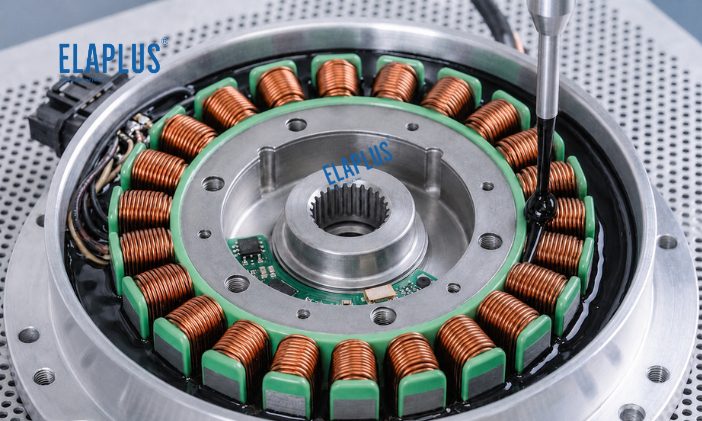
Quick Comparison of the Two Products
| Index | EP 1716 (Standard Grade) | EP 1796-2# (Advanced Grade) |
| Type | Two-component thermally conductive epoxy | Anhydride-based thermosetting epoxy |
| Thermal Conductivity (W/mK) | 1.5 | 2.0 – 2.5 |
| Glass Transition Temperature Tg (℃) | 95 – 105 | 140 – 165 |
| Long-Term Operating Temperature (℃) | −50 ~ 180 | −60 ~ 200 |
| CTE (below Tg, μm/m·℃) | 25 | 23 – 33 |
| Dielectric Strength (kV/mm) | ≥18 | ≥18 |
| Volume Resistivity (Ω·cm) | 1×10¹⁵ | 1×10¹⁵ |
| Hardness (Shore D) | 90 | 85 – 95 |
| Mixing Ratio A:B | 100:5 | 100:12 ~ 100:15 |
| Curing Schedule | 25℃/24h or 80℃/3h | 80℃/2h + 130℃/2h |
| Positioning | General-purpose mainstream grade, room-temperature curable | Higher temperature resistance & higher thermal conductivity |
Frequently Asked Questions about Potting for Frameless Torque Motor Stators
Q1: Why is potting necessary for frameless torque motors?
High torque density leads to concentrated heat generation. Potting realizes heat conduction, electrical insulation and structural fixation; otherwise, overheating and insulation failure will occur.
Q2: Which potting compound is suitable for robot joint motors?
Thermally conductive epoxy potting compounds such as EP 1716 are recommended, specially formulated for stators of frameless torque motors and robot joint drive systems.
Q3: What applications is EP 1716 applicable to?
Stators of frameless torque motors
Robot joint motors
Electric drive systems
High-power electronic modules
Q4: Why choose epoxy potting compounds?
Epoxy systems provide:
■ High-strength structural fixation
■ High Tg and stable temperature resistance
■ Low creep and deformation resistance
■ High loading capacity for thermally conductive fillers
■ Excellent electrical insulation performance
They are especially ideal for high-stress structural components like motor stators.
Q5: What are the core strengths of EP 1716?
■ High thermal conductivity (1.5 W/m·K)
■ Low CTE and outstanding crack resistance
■ Stable performance across −50℃ ~ 180℃ wide temperature range
■ Superior long-term structural reliability