With the advancement of AI technology, motion control algorithms and high-power-density motor technology, humanoid robots are evolving from conceptual designs into mass-produced products. Every joint, including robotic arms, knees, hips, ankles and dexterous hands, relies on motor systems featuring fast response, high torque and high precision.
Frameless torque motors have become the core choice for driving humanoid robot joints. Featuring compact structure, light weight and high torque density, they can be directly integrated into robot joints, perfectly catering to the design requirements of miniaturization, lightweight design and high dynamic response for humanoid robots. As documented, frameless torque motors deliver fast response, low friction and high efficiency, well suited for joint drive applications of humanoid robots.
However, challenges arise alongside these advantages:
The smaller and more powerful a motor is, the harder it is to dissipate heat.
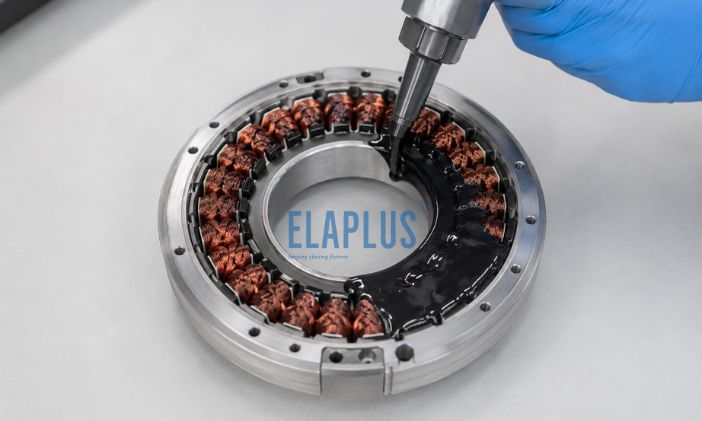
For robot joint motors, frameless torque motors and servo motor stators, potting adhesives serve not only as protective materials, but also as key functional components for motor thermal management.
ELAPLUS motor potting adhesives are specially formulated for humanoid robot motors. They deliver outstanding performance in thermal conduction and heat dissipation, electrical insulation, winding fixation, vibration resistance and long-term operational reliability for robot joint motors.
1. Why Do Humanoid Robots Adopt Frameless Torque Motors?
A frameless torque motor is a frameless permanent magnet brushless synchronous motor, mainly composed of a rotor and a stator. The rotor is a rotating steel ring embedded with permanent magnets and can be directly mounted on the machine shaft. The stator consists of laminated silicon steel sheets and copper windings that generate electromagnetic force and are integrated inside the housing.
Compared with conventional motors, frameless torque motors offer distinct advantages for humanoid robots:
■ High torque density: Delivers higher torque output within the limited space of robot joints.
■ Low inertia: Enables faster dynamic response and more flexible robot movements.
■ Compact integration: Can be embedded directly into joint structures to save space.
■ High efficiency: Direct-drive design reduces power transmission loss.
■ Precise control: Works with high-resolution encoders to achieve accurate position and speed control.
Thanks to the above merits, motors for robot joints, frameless torque motors and joint module motors impose stricter requirements on materials: compact size with high power output, fast response with long-term reliability, and integrated structure without heat accumulation.
2. Core Pain Point of Robot Joint Motors: Thermal Management
Torque motors act as the “heart” of joint movement in humanoid robots. When robots perform actions such as walking, gripping, standing, load bearing, jumping and turning, joint motors need to continuously output torque.
High power density inevitably leads to excessive heat generation. As indicated in relevant documents, torque motors of humanoid robots produce massive heat in confined spaces, while traditional passive heat dissipation methods often fail to meet requirements — especially for load-bearing joints like hips and knees that demand higher power.
Consequences of inadequate thermal management:
■ Excess temperature rise of motor windings
■ Reduced torque output
■ Declined motion accuracy
■ Poor stability of encoders and sensors
■ Accelerated aging of motor insulation systems
■ Thermal deformation of structural components
■ Shortened service life of joint modules
■ Deteriorated overall equipment reliability
For humanoid robots, failure of a single joint will impair the coordinated movement of the entire robot. Therefore, the core value of potting adhesives for robot joint motors is to build stable heat conduction paths for motor windings, while enhancing structural and electrical reliability.
3. Why Do Robot Joint Motors Need Potting Adhesives?
The stator winding is the main heat source of a frameless torque motor. Restricted by the compact structure, gaps between coils, iron cores and housings are extremely narrow. Heat will accumulate around windings if it cannot be quickly conducted to the housing or heat dissipation structures.
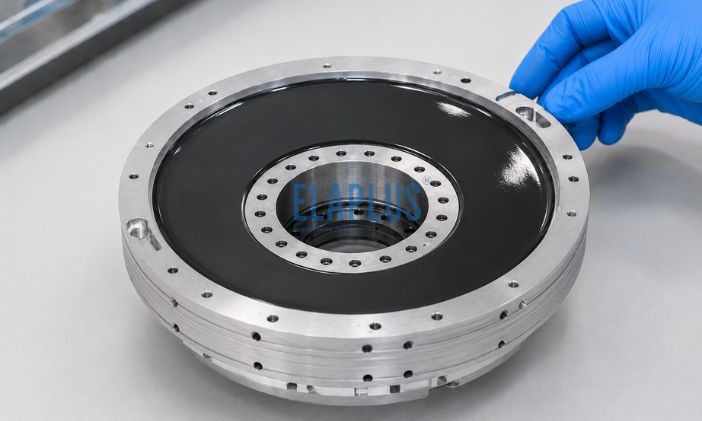
ELAPLUS potting adhesives for humanoid robot motors fully fill gaps between windings and housings to form continuous heat conduction channels, transferring heat from coils to motor housings and lowering local temperature rise effectively.
■ Thermal Conduction & Heat Dissipation to Reduce Hot Spots
Thermally conductive epoxy potting adhesives efficiently conduct heat generated by motor windings and optimize internal heat distribution. Widely adopted as a thermal management solution for torque motors, these adhesives help dissipate heat from windings and lower operating temperatures.
■ Coil Fixation to Resist Vibration and Displacement
Robot joint motors frequently start, stop, accelerate, decelerate and reverse, subjecting windings to continuous vibration and mechanical impact. Fully cured potting adhesives firmly fix coils, eliminating winding loosening, abnormal noise and fatigue failure risks.
■ Electrical Insulation for Operational Safety
Windings inside frameless torque motors are densely arranged. Long-term operation may lead to electric leakage, short circuits and dielectric breakdown without proper protection. Premium epoxy potting adhesives provide reliable electrical insulation for motor windings. They also offer comprehensive protection including mechanical reinforcement, chemical stability and flame retardancy.
■ Moisture & Dust Resistance for Enhanced Environmental Adaptability
Humanoid robots are deployed in diverse scenarios including industry, services, logistics, medical care and outdoor inspection. Potting treatment protects windings and insulation structures from moisture, dust and contaminants.
■ Long-term Reliability to Withstand Wide Temperature Fluctuations & Thermal Cycling
Robot joint motors experience dramatic temperature changes during operation. Our potting adhesives feature excellent thermal stability, low coefficient of thermal expansion (CTE) and outstanding crack resistance, preventing adhesive cracking, delamination and insulation degradation caused by thermal cycling.
4. ELAPLUS Potting Adhesive Solutions for Humanoid Robot Motors
Targeting robot joint motors, frameless torque motors and servo motor stators, ELAPLUS provides a full range of thermally conductive epoxy potting materials tailored to different thermal management demands.
Elaplus EP 1716: Class H industrial-grade epoxy adhesive with thermal conductivity of 1.5–1.6 W/m·K and a maximum operating temperature of 180℃. Ideal for standard industrial robot motors.
Elaplus EP 2040: Customized thermal management solution for robots, with thermal conductivity up to 2.16 W/m·K and an operating temperature range from -60℃ to +200℃.
We offer professional material selection services for customers searching for motor potting adhesives, potting compounds for robot joint motors and frameless torque motors:
■ High thermal conductivity epoxy potting adhesives
■ Low CTE crack-resistant potting adhesives
■ Class H high-temperature resistant motor potting adhesives
■ Thermal management materials for robot torque motors
■ Potting solutions for frameless torque motor stators
■ Formulations compatible with automated dispensing processes
5. Core Advantages of ELAPLUS Potting Adhesives for Humanoid Robot Motors
■ High Thermal Conductivity to Optimize Heat Dissipation Paths
Windings of humanoid robot joint motors generate concentrated heat in limited space. Our thermally conductive potting adhesives fully fill gaps between windings and housings to establish efficient heat conduction paths, effectively reducing hot spot temperatures.
■ Low CTE to Minimize Cracking Risks under Thermal Cycling
Motor interiors consist of copper wires, iron cores, aluminum housings and insulation layers with different coefficients of thermal expansion. Temperature cycling creates internal stress. Low-CTE potting adhesives relieve such stress and prevent adhesive cracking, coil delamination and insulation failure.
■ Reliable Electrical Insulation to Secure Long-term Operation
Robot joint motors run at high frequencies under complex loads, making winding insulation reliability a top priority. Our epoxy potting adhesives deliver stable electrical insulation and reduce risks of electric leakage, short circuits and dielectric breakdown.
■ Mechanical Protection to Stabilize Windings against Vibration
Frequent joint movements expose motor stators to persistent vibration and impact. Cured potting adhesives strengthen the overall structure of windings, preventing loosening, abnormal noise and fatigue damage.
■ Excellent Process Compatibility for Automated Dispensing & Mass Production
As humanoid robots move from prototype to mass production, materials must combine reliable performance with good processability. Standard working procedures include motor preparation & cleaning, adhesive mixing & defoaming, precision potting, curing control and quality inspection.
Elaplus customizes material solutions for mass production based on customers’ motor structure, winding depth, potting height, curing requirements and production cycle.
6. Typical Application Scenarios
■ Potting for Humanoid Robot Joint Motors
Potting for stators of torque motors installed on knees, hips, ankles, shoulders, elbows and other joints, providing thermal conduction, insulation and structural protection.
■ Potting for Frameless Torque Motors
Potting for stator windings of frameless torque motors to improve heat conduction efficiency and winding fixation reliability.
■ Potting for Robot Joint Modules
Encapsulation and protection for motors, sensors, windings and electrical connections inside integrated joint modules.
■ Potting for Servo Motor Stators
Stator potting for servo motors used in industrial robots, collaborative robots and automated equipment.
■ Thermal Management for High-power-density Motors
Suitable for high-power-density motors requiring high thermal conductivity, low CTE, crack resistance and long-term temperature resistance.
7. Process Recommendations for Reliable Robot Motor Potting
■ Motor Preparation & Cleaning
Thoroughly clean windings, housings, iron cores and slots to remove oil, dust, moisture and impurities, ensuring full adhesion between adhesive and substrates.
■ Adhesive Mixing & Defoaming
Weigh Component A and Component B strictly in the specified ratio, mix thoroughly and conduct vacuum defoaming. Bubbles will severely compromise thermal conductivity and electrical insulation performance.
■ Precision Potting
Use automated dispensing or potting equipment to cover windings evenly and fully fill gaps and cavities.
■ Curing Control
Adopt room-temperature or heat curing according to adhesive specifications. Control curing temperature and duration strictly to ensure complete curing.
■ Quality Inspection
Verify potting quality via visual inspection, insulation testing, thermal imaging and thermal performance evaluation.
8. FAQ about Potting Adhesives for Robot Motors
Q1: What type of adhesive is recommended for robot joint motor potting?
Thermally conductive epoxy potting adhesives with high thermal conductivity, low CTE, excellent crack resistance, stable electrical insulation and good temperature resistance are the ideal choice. ELAPLUS potting adhesives are applicable to frameless torque motors, servo motor stators and robot joint modules.
Q2: Why do frameless torque motors require potting?
Frameless torque motors feature compact structure and high power density, leading to concentrated heat generation at windings. Potting adhesives fill internal gaps to build heat conduction paths, as well as fix coils and provide moisture-proof and insulation protection.
Q3: What main problems can potting adhesives for humanoid robot motors solve?
They break heat dissipation bottlenecks for high-power-density motors, and solve problems including winding loosening, poor electrical insulation, moisture and dust intrusion, cracking caused by thermal cycling and insufficient long-term reliability.
Q4: What applications are robot motor potting adhesives suitable for?
They are widely used for humanoid robot joint motors, frameless torque motors, servo motor stators, robot joint modules, industrial robot motors and thermal management of high-power-density motors.
Q5: What key points should be noted during robot joint motor potting?
Key points include thorough cleaning of windings, accurate mixing ratio of two components, sufficient vacuum defoaming, uniform potting, strict control over curing temperature and time, as well as post-potting insulation and thermal performance tests.
Conclusion: Core Requirements for Humanoid Robot Motor Potting — Heat Dissipation + Insulation + Reliability
Humanoid robot joint motors are developing towards higher power density, smaller size and faster response speed. For frameless torque motors, thermal management has become a decisive factor affecting torque output, motion accuracy and service life.
Equipped with high thermal conductivity, low CTE, superior crack resistance, stable electrical insulation and good process adaptability, ELAPLUS provides reliable potting solutions for robot joint motors, frameless torque motors and servo motor stators.
As a professional material solution provider, ELAPLUS offers full support ranging from material selection to process verification for customers looking for potting adhesives for robot motors.
ELAPLUS — Making Humanoid Robot Joint Motors More Stable, Efficient and Reliable.