MEMS pressure sensors, inertial sensors, accelerometers, gyroscopes, microphones and other devices generally incorporate miniature sensitive chips, micromechanical structures and precision electrodes.
Such components are extremely susceptible to mechanical stress. Excessive cure shrinkage or high modulus of encapsulation adhesives, or a large mismatch in coefficient of thermal expansion (CTE) between the adhesive and chips, may lead to zero drift, sensitivity deviation and even structural damage.
Therefore, when selecting MEMS encapsulation adhesives, bonding strength alone is not sufficient; priority should also be given to whether the material can relieve stress.
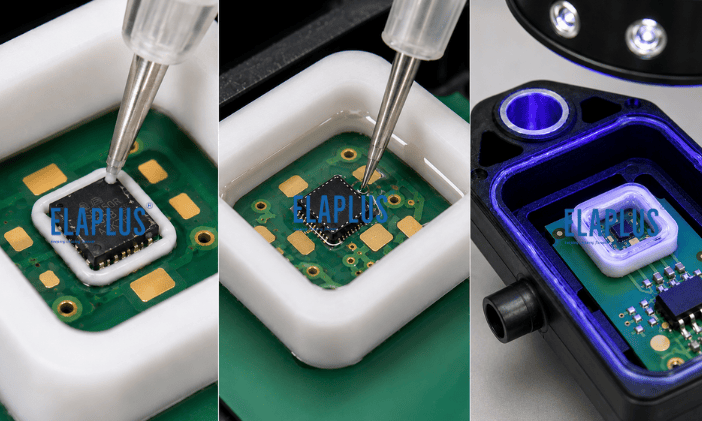
I. Three Common Adhesive Application Zones in MEMS Packaging
1. Precision Bonding of MEMS Chips
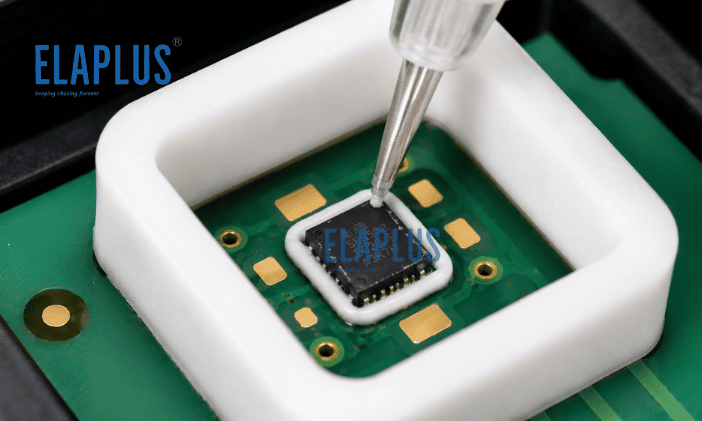
Chips need to be accurately fixed onto substrates while avoiding excessive shrinkage stress exerted on chips by cured adhesives.
Required material properties:
■ Low cure shrinkage
■ Good positional retention
■ Thermal expansion performance matched with substrates
■ Stable bonding strength
■ Compatibility with precision dispensing or active alignment processes
2. Electrode Protection for MEMS Chips
Electrodes and bonding areas require protection against moisture, corrosion and vibration, yet must not be fully constrained by high-hardness materials.
Low-modulus silicone gels or flexible silicones can form a protective layer while reserving certain displacement space for chips and bonding wires.
3. Lid Bonding & Housing Sealing
MEMS lid sealing must block moisture vapor and contaminants. Additional requirements may include electrostatic discharge (ESD) protection, optical stability and dispensing within narrow gaps.
II. Eilian Recommended Adhesive Grades for MEMS Packaging
SIPA 3000 One-Part Addition-Cure Silicone
One-part semi-flowable silicone adhesive and sealant; viscosity ~40,000 cps; hardness Shore A 28 after curing; elongation >250%.
Recommended applications:
■ MEMS lid bonding
■ Housing sealing
■ Flexible reinforcement of solder joints
■ Areas requiring both adhesion and stress buffering
High elongation helps absorb displacement induced by vibration and thermal expansion.
SIPA 3003 Chip Mounting Adhesive
One-part semi-fluid silicone; viscosity ~20,000 cps; hardness Shore A 50; elongation >200%.
Suitable for device sealing and fixation requiring moderate flow and filling capacity together with satisfactory mechanical support.
SIPA 3008 One-Part Heat-Curable Silicone
Highly thixotropic one-part silicone; viscosity ~300,000 cps; thixotropy index ~4.5.
Recommended applications:
■ Local solder joint reinforcement
■ Vertical surface or edge dispensing
■ Packaging structures where uncontrolled adhesive flow is undesirable
■ Peripheral fixation of precision components
■ High thixotropy improves dispensing profile retention and reduces contamination risks on sensitive areas.
SIGEL 3060-2K Chip Encapsulation Gel
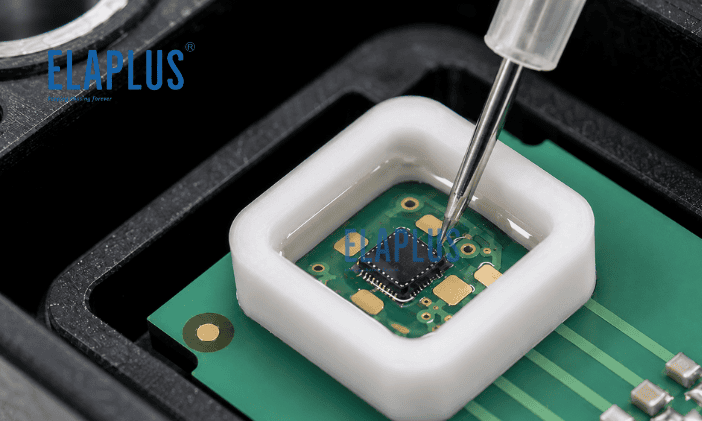
1:1 two-part solvent-free silicone gel with low viscosity, ideal for filling precise narrow gaps. Cured gel features low modulus to buffer external impact and thermal cycling stress.
Recommended applications:
■ MEMS electrode protection
■ Low-stress chip encapsulation
■ Precision bonding wire protection
■ Sensor structures sensitive to mechanical stress
SIGEL 3080-2K Chip Encapsulation Gel
1:1 two-part thixotropic silicone gel balancing low stress and dispensing positional retention.
Compared with self-leveling silicone gels, it is more suitable for partial encapsulation, peripheral chip protection and structures with defined dispensing boundaries.
EP UV 2086 UV-Curable Epoxy Adhesive
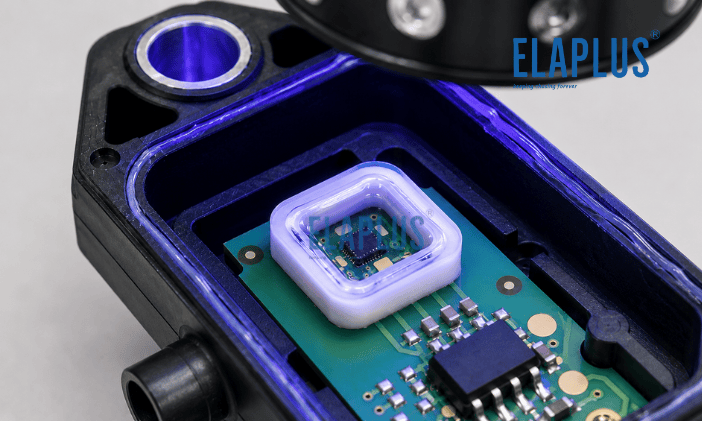
One-part UV-curable epoxy designed for precision packaging processes demanding fast positioning and in-line curing.
Typical uses:
■ Chip mounting
■ Lid bonding
■ Rapid positioning of precision components
■ Automated dispensing production lines
When adopting UV materials, verify UV energy, adhesive layer thickness and sufficient curing within shadow zones.
III. Key Factors Not to Be Overlooked in MEMS Encapsulation Adhesive Selection
High Hardness ≠ High Reliability
Although high-hardness materials deliver robust fixation, they may directly transfer thermal stress to MEMS chips.
For pressure, inertial and micro-displacement sensors, low stress is generally more critical than pure hardness.
Control Adhesive Volume and Coating Thickness
Even low-shrinkage materials may cause chip tilting and asymmetric stress if over-dispensed or unevenly coated.
Validation for Optical and Inspection Processes
Some MEMS devices require optical inspection or active alignment. Testing should cover adhesive transparency, fluorescence background, yellowing resistance and photo-curing stability.
Mandatory Reliability Testing
It is advised to conduct tests including temperature cycling, 85°C/85%RH damp heat test, vibration, drop test, salt spray resistance and medium compatibility according to actual service conditions.
IV. Conclusion on MEMS Packaging Material Selection
The core principle for bonding and protecting MEMS chips is not to encapsulate devices as rigidly as possible. Instead, while meeting requirements for fixation, moisture resistance and insulation, minimize the impact of adhesives on sensitive structures.
With the SIPA silicone adhesive series, SIGEL low-stress silicone gel series and EP UV fast-curing series, Eilian offers diverse process solutions for MEMS chip bonding, electrode protection and lid sealing.