Every servo motor engineer knows that stator potting may seem straightforward, yet it is full of hidden pitfalls in real-world production.
Heat generation, cracking, thermal expansion, and temperature resistance — any one of these issues can lead to scrapped batches of products. To make matters worse, countless potting adhesive brands flood the market with overwhelming technical datasheets. A wrong adhesive selection can even halt your production line.
Today we cut to the chase and introduce a high-performance product tailored for servo motor stator potting: ELAPLUS EP 1716 thermally conductive two-part epoxy potting compound. Why this product? We break down its advantages against the four core requirements for servo motor stator potting one by one.
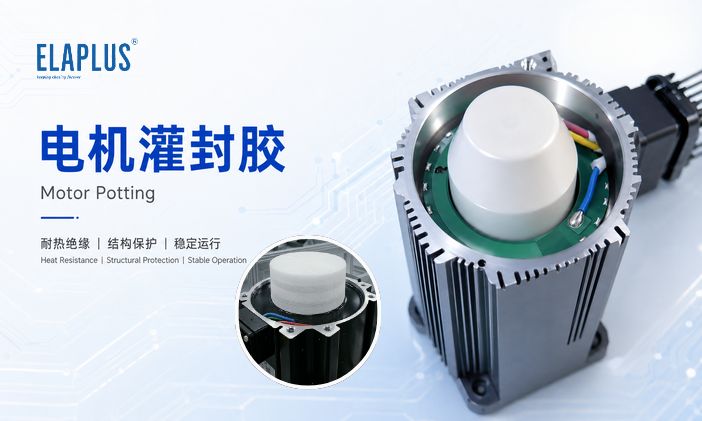
1. High Heat Generation? Thermal Conductivity Must Be Up to Standard
Under high-speed and high-torque operating conditions, stator windings of servo motors generate massive heat. If the thermal conductivity of potting adhesive cannot keep up, heat accumulates inside the stator, reducing motor efficiency at best and burning out windings at worst.
This is why thermal conductivity is the primary screening criterion for adhesive selection.
Comparison of three products:
■ EP 1715: Thermal conductivity 0.6 W/mK
■ EP 1715(3#): Thermal conductivity 1.0 W/mK
■ EP 1716: Thermal conductivity 1.5 W/mK
EP 1716 features 2.5-fold higher thermal conductivity than EP 1715 and 50% higher than EP 1715(3#). In practical applications, this means internal stator heat dissipates faster to the housing, lowering motor temperature rise and greatly improving reliability during continuous operation.
For high-power-density servo motors, a thermal conductivity of 1.5 W/mK delivers tangible competitive edge.
2. Cracking Under High–Low Temperature Cycling? Aging Test Data Speaks for Itself
Servo motors operate in far harsher environments than laboratory conditions. From cold storage with temperatures dropping to tens of degrees below zero in northern China, to hot‑humid workshops in southern China, or sharp temperature fluctuations caused by frequent start‑stop cycles, potting adhesive cracking will lead to stator insulation failure and total motor breakdown.
Cracking essentially results from weakened bonding strength between the adhesive, windings and iron core under environmental stress.
EP 1716 excels remarkably in this aspect. Below are three aging test results for iron-to-iron shear strength (initial value: 11.2 MPa):
| Aging Test Type | Initial | 200 h | 400 h | 600 h | 800 h | 1000 h |
| 85 °C / 85%RH High Temp & Humidity | 11.2 | 12.5 | 13.2 | 12.8 | 12.5 | 12.2 |
| High Low Temp Cycling (-40~125 °C) | 11.2 | 11.8 | 12.3 | 12.6 | 12.0 | 11.9 |
| High Temp Storage at 120 °C | 11.2 | 11.8 | 12.2 | 12.6 | 12.8 | 12.8 |
Shear strength does not decrease after aging but even increases. After 1000 hours of 85 °C/85%RH aging, shear strength remains 12.2 MPa, while it reaches 12.8 MPa after 1000 hours of 120 °C high‑temperature storage. This indicates EP 1716’s bonding system undergoes continuous post‑curing under thermal conditions with higher crosslink density, forming stronger and tougher interfacial bonds.
Rising shear strength after aging directly proves its superior crack resistance.
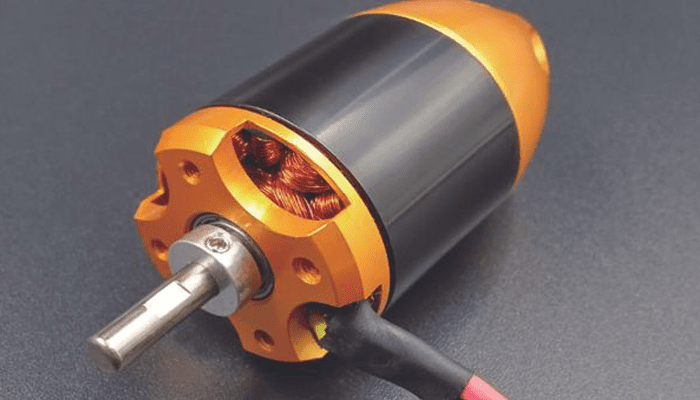
3. Mismatched Thermal Expansion? Both CTE and Tg Matter
Many engineers only focus on thermal conductivity when selecting adhesives. After hundreds of operating hours, tiny gaps form between the stator iron core and potting adhesive, reducing insulation performance and intensifying partial discharge.
The root cause lies in the Coefficient of Thermal Expansion (CTE). Copper windings have a CTE of approximately 17 μm/m·°C, and silicon steel sheets around 12 μm/m·°C. Excessively high CTE of potting adhesive causes inconsistent expansion and contraction during thermal cycling, leading to accumulated interfacial stress, delamination and debonding.
CTE comparison of three products (below glass transition temperature Tg):
■ EP 1715: 42 μm/m·°C — too high for precision servo motors
■ EP 1715(3#): 23 μm/m·°C — good, close to copper windings
■ EP 1716: 25 μm/m·°C — comparable to EP 1715(3#), far superior to EP 1715
CTE alone is insufficient. Glass transition temperature (Tg) determines the temperature range where low‑CTE performance is maintained.
For EP 1716, Tg reaches 95 °C after curing at 80 °C for 3 hours and 105 °C after curing at 120 °C for 2 hours. In contrast, EP 1715(3#) only has a Tg of 85 °C.
This means EP 1716 maintains low-expansion properties over a wider temperature range. Stator temperature often hits 120 °C or higher during servo motor operation. Under such conditions, EP 1716 remains in the low-CTE range (25 below Tg, 62 above Tg), whereas EP 1715(3#) enters high-expansion state above 85 °C. Long‑term reliability is self-evident.
4. Is It Heat–Resistant Enough? Reliable Performance from -50 °C to 180 °C
Servo motors generally require Class‑F insulation (155 °C) or higher. The temperature resistance of potting adhesive directly determines motor service life.
EP 1716 features an operating temperature range of -50 °C to 180 °C, covering all working scenarios of servo motors from extreme‑cold shutdown to high-temperature full-load operation. More importantly, it retains excellent mechanical properties at high temperatures: Shore D hardness of 90 and Tg up to 105 °C (under 120 °C curing), maintaining outstanding rigidity and bonding strength at elevated temperatures.
While EP 1715(3#) is also rated for 180 °C operating temperature, its Tg is only 85 °C. Above 85 °C, the adhesive softens with significantly reduced hardness, compromising long-term reliability under continuous operation above 150 °C.
For high-end servo motors requiring Class‑S insulation (180 °C), EP 1716 with a Tg of 105 °C via 120 °C curing is clearly a more suitable option.
The comparison table clearly shows EP 1716 achieves the best overall balance in four critical dimensions: thermal conductivity, CTE control, Tg and aging performance. EP 1715(3#) shows obvious inferiority in aging performance, while EP 1715 lags significantly in thermal conductivity and CTE.
5. Practical Processing Guidelines for EP 1716
Besides performance, process adaptability is vital for production engineers.
Mixing Ratio: 100:5 by weight, more cost-effective curing agent dosage.
Compared with EP 1715 (100:15) and EP 1715(3#) (100:8), EP 1716 only requires 5 parts of curing agent, lowering costs and minimizing performance fluctuations caused by inaccurate Part-B weighing.
Flexible Curing Methods:
■ Room-temperature curing: 24 hours at 25 °C, suitable for production lines without ovens
■ Medium-temperature curing: 3 hours at 80 °C for optimized overall performance
■ High-speed high-temperature curing: 2 hours at 120 °C with Tg up to 105 °C, ideal for applications requiring extreme temperature resistance
Operational Notes:
■ Part-A contains high-density fillers; stir thoroughly in the drum before use
■ Par-B reacts with moisture when exposed to air; keep sealed during weighing
■ Vacuum degassing is recommended after potting to enhance electrical insulation performance
■ Pot life is around 60 minutes for 1 kg mixed adhesive at 25 °C; plan usage rationally
Stator potting adhesive selection for servo motors hinges on four metrics: sufficient thermal conductivity, crack resistance, matched thermal expansion and high-temperature tolerance. EP 1716 delivers verified performance in all four aspects:
■ Thermal conductivity of 1.5 W/mK, the highest among the three products
■ Increased shear strength after 1000-hour aging in three tests, proven crack resistance
■ 25 μm/m·°C CTE paired with 95–105 °C Tg for low expansion over wide temperature ranges
■ Operating temperature from -50 °C to 180 °C with Shore D 90 hardness and excellent high-temperature mechanical performance
EP 1716 is worth serious evaluation if your servo motors demand high thermal conductivity and temperature resistance.
6. Common Questions on Motor Stator Potting
Q1: What material is suitable for servo motor stator potting?
Servo motor stator potting requires epoxy potting compounds with high thermal conductivity, low CTE, crack resistance, high‑low temperature resistance and stable electrical insulation. ELAPLUS EP 1716 features low CTE, high thermal conductivity, crack resistance and long-term performance from -50 °C to 180 °C, ideal for stators with high heat generation and obvious thermal cycling.
Q2: Why is low CTE critical for servo motor stator potting?
Low CTE reduces thermal expansion and contraction of potting adhesive during high‑low temperature cycling, lowering thermal stress between adhesive, copper wires, iron cores and insulation materials, thus minimizing cracking, debonding and insulation failure risks.
Q3: Why is EP 1716 suitable for servo motor stator potting?
EP 1716 is a thermally conductive two-part epoxy potting compound with low CTE, high thermal conductivity, superior adhesion, crack resistance, stable electrical insulation and long-term performance from -50 °C to 180 °C. It is widely used for high-thermal-conduction encapsulation and protection in motors, automotive electronics, power tools, reactors and instruments.
Q4: What are the differences between EP 1716, EP 1715 and EP 1715-3#?
EP 1716: Preferred for servo motor stator potting requiring high thermal conductivity, low CTE and crack resistance
EP 1715: Suitable for motor/sensor potting with UL94 V‑0 flame retardancy and good flowability for gap filling
EP 1715-3#: Designed for high‑temperature resistance, UL V-0 certification and long-term use at 150–180 °C for motors and automotive electronics encapsulation
Q5: Why vacuum degassing is needed for motor stator potting?
Motor stators have complex structures with air bubbles easily trapped between windings and slots. Vacuum degassing eliminates bubbles, improving adhesive filling integrity, thermal conduction continuity and electrical insulation reliability.
Final Note: Thermal Conductivity, Low CTE and Crack Resistance Are Core to Stator Potting
Servo motor stator potting is more than gap filling; it is systematic material selection focusing on heat dissipation, insulation, crack resistance, temperature tolerance and long-term reliability.
For servo motor stators with high heat generation, obvious thermal cycling, low‑CTE and crack‑resistance requirements, ELAPLUS EP 1716 high-thermal-conductivity epoxy potting compound is the top solution.
Elaplus also offers complementary grades including EP 1715 and EP 1715-3# to meet diverse requirements such as UL94 V‑0 flame retardancy, gap filling and high-temperature certification, providing reliable potting materials for servo motors, permanent‑magnet motors, automotive electronics, power tools, reactors and other industries.
ELAPLUS — More Reliable Motor Potting, More Stable High-Power Equipment Operation.

Previous post: Sealing for E-Drive Copper Busbar Connectors in NEVs:Why All Traditional Solutions Failed — and How Elaplus Flexible Epoxy EP 1721-1 Succeeded
Next post: How to Select Potting Compounds for Automotive Controllers?ELAPLUS SIPA 1850 High-Thermal-Conductivity & Flame-Retardant Potting Solution