A palm-sized stator winding carries hundreds of amperes of electric current; a drive motor generates continuous heat at rotational speeds of tens of thousands of revolutions per minute. Potting compound serves as the final safeguard securing motor operational safety.
If motors are the “hearts” of new-energy vehicles and industrial automation, motor potting compounds are the “pericardia” protecting these hearts. They must deliver efficient heat conduction and dissipation, reliable electrical insulation, and resistance to extreme temperature shocks ranging from -50°C to 180°C. Should the wrong compound be chosen for this triple-mission task, the consequence could be full-product recalls.
Cutting straight to the point, today we introduce ELAPLUS EP 1716, a high-thermal-conductivity epoxy potting compound that excels specifically in motor stator potting applications. We back our claims with solid performance parameters.
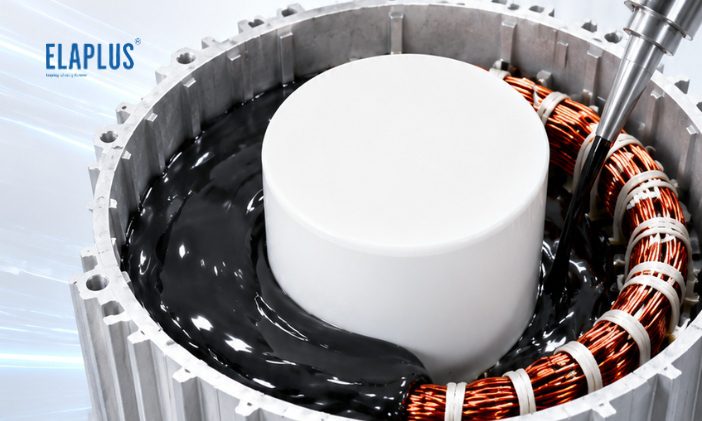
I. Why Is Motor Potting Becoming Increasingly Demanding?
Latest data shows the global potting compound market reached approximately USD 3.9 billion in 2025, among which automotive thermal‑conductive potting compounds alone exceeded USD 1.2 billion, projected to surge to USD 2.5 billion by 2034. This growth is primarily driven by the booming new-energy vehicle, industrial servo motor and 5G electronic packaging sectors.
Take new-energy vehicles as an example. The power density of mainstream drive motors has risen from the early 2-3 kW/kg to 5-7 kW/kg or higher today. Doubled power density means nearly doubled heat generation per unit volume of windings. Meanwhile, the rapid rollout of 800 V high-voltage platforms has raised requirements for motor insulation systems from “basic sufficiency” to “absolute reliability”.
In traditional processes, motor stator windings are fixed and protected mainly by impregnating varnish. Yet such varnishes typically feature a thermal conductivity of only 0.2–0.3 W/m·K with insufficient filling capacity, leaving massive air gaps between coils and iron cores. Air, with a thermal conductivity of merely 0.026 W/m·K, acts as a natural thermal barrier.
Trapped heat accelerates insulation aging. Once insulation fails, the motor becomes non-functional.
Hence high-thermal-conductivity epoxy potting compounds emerged. They must fill every micro-gap, firmly bond each coil turn, rapidly transfer heat generated by windings to the housing and cooling system, and withstand repeated thermal cycling without cracking. These constitute the real technical thresholds of potting compounds.
II. EP 1716: An Epoxy Potting Material Engineered Exclusively for Motor Potting
ELAPLUS EP 1716A/B is a two-component solvent-free high-thermal-conductivity epoxy potting compound developed for motor stator potting, automotive electronics, power tools, reactors and more. Below are its core parameters and engineering implications:
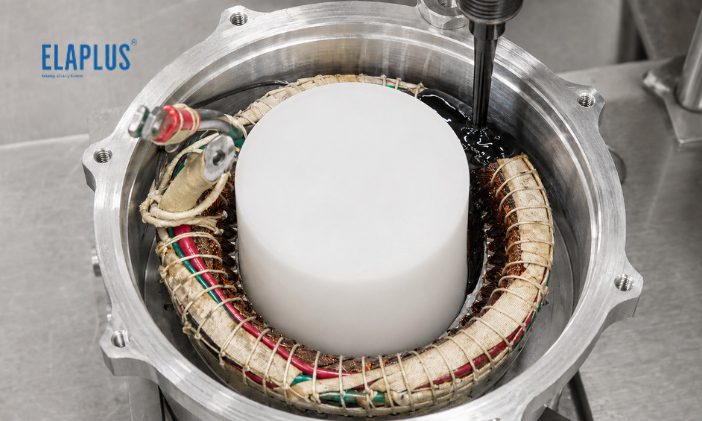
■ Thermal conductivity: 1.5 W/m·K, around 56 times that of air and 5-7 times that of ordinary impregnating varnish.
■ Glass transition temperature (Tg): 105°C, which keeps the material rigid at high temperatures without softening or creep.
■ Temperature resistance range: -50°C to 180°C, satisfying long‑term service requirements for Class-H insulation (180°C).
■ Mixed viscosity: 6,000 mPa·s, offering an ideal balance between fluidity and filling capability.
■ Mixing ratio: 100:5, featuring a wide processing window and high fault tolerance.
è èCuring conditions: 24 hours at 25°C ambient temperature; heat-accelerated curing is also available for high production-line flexibility to adapt to different production rhythms.
What do these figures actually mean? Let’s break them down one by one.
III. Four Core Technical Advantages Targeting Critical Motor Potting Pain Points
1.Advantage 1: 1.5 W/m·K Thermal Conductivity – More Than a Figure, a Passport to Higher Motor Power Density
Thermal conductivity is engineers’ primary consideration when selecting potting compounds- and rightly so. Yet higher thermal conductivity is not always better. Excess thermal fillers drastically increase viscosity, degrade fluidity and cause incomplete potting, forming new thermal resistance traps.
EP 1716’s 1.5 W/m·K thermal conductivity is an engineering-validated optimal balance. For stator potting of drive motors, servo motors and permanent-magnet synchronous motors, this thermal conductivity builds efficient heat transfer paths, reducing winding hot-spot temperatures by 10–20°C to notably slow insulation aging and extend motor service life. Meanwhile, its 6,000 mPa·s viscosity ensures full penetration into deep winding sections with no dead zones.
2.Advantage 2: 105°C Tg + 180°C Upper Temperature Limit – No Softening Under High Heat
Glass transition temperature (Tg) is one of the most critical parameters for epoxy potting materials. Simply put: when operating temperature exceeds Tg, epoxy resin transitions from glassy to rubbery state, with sharply increased thermal expansion coefficient and drastically weakened bonding strength, causing potting layers to peel off copper wires — a phenomenon engineers call “softening failure”.
With a Tg of 105°C and an upper temperature resistance limit of 180°C, EP 1716 maintains structural integrity and electrical insulation performance even under extreme Class-H insulation operating conditions (180°C). Such softening-free protection is essential for new-energy drive motors and industrial servo motors running in high-temperature environments.
3.Advantage 3: Low Coefficient of Thermal Expansion (CTE) – Resists Copper Wire Delamination from Thermal Cycling
Motors undergo frequent start-stop, load-unload cycles, with winding temperatures fluctuating drastically between ambient temperature and over 100°C. Copper features a linear thermal expansion coefficient of ~17 ppm/°C, while intrinsic epoxy resin CTE normally ranges from 50 to 70 ppm/°C. Excessive CTE mismatch triggers micro-tearing with every thermal cycle. Cumulative damage eventually causes potting layer cracking and insulation failure.
Through optimized filler systems and resin modification, EP 1716 achieves a low CTE for better thermal expansion matching with copper conductors. Superior crack resistance ensures intact potting layers even after thousands of thermal cycles.
4.Advantage 4: Ultra–Low Water Absorption & Excellent Electrical Insulation–Stable Performance in Humid Conditions
Moisture penetration is another major cause of insulation failure for motors operating in humid or outdoor environments. Fully cured EP 1716 exhibits ultra-low water absorption and superior waterproofing, delivering long-term stable protection for reactors, outdoor instruments and power tools. Its outstanding electrical insulation prevents breakdown under high-voltage stress.
IV. Proven Application Scenarios for EP 1716
New–Energy Vehicle Electric Drive Systems
Stator potting for drive motors is EP 1716’s core application. Against trends of higher power density and high-voltage platforms, its high thermal conductivity and wide temperature range deliver robust reliability for electric drive systems.
Industrial Servo Motors
Servo motors feature frequent start-stop and forward-reverse rotation, demanding extreme thermal shock resistance and bonding strength for potting compounds. EP 1716’s low CTE and excellent adhesion fully satisfy such requirements and has been mass-applied in multiple servo motor projects.
Power Tool Motors
Handheld power tools are compact with high power density and poor heat dissipation. EP 1716 rapidly transfers heat from stator windings to housings, stabilizing tool performance during long-duration high-load operation.
Reactors & Instrument Encapsulation
EP 1716 serves as an all-rounder for power reactors, precision instruments and other applications requiring balanced insulation, heat dissipation and environmental protection.
V. Potting Compound Selection Is More Than Parameter Checking – It Is Partner Selection
The gap between lab-tested potting compound data and stable mass-production application lies in process adaptability, batch consistency and technical support. As a professional supplier of organic polymer adhesives, ELAPLUS provides a full portfolio of electronic potting compounds including epoxy, silicone and polyurethane systems, alongside a complete technical service workflow covering selection consultation and process optimization.
For core motor potting products such as EP 1716, ELAPLUS offers in-depth technical support including viscosity adjustment, curing process optimization and production line adaptation suggestions. Potting is a critical motor assembly procedure: select the right compound, and apply it correctly.
Motor potting compound selection essentially solves a four-way coupled challenge of heat, mechanics, electricity and environment. Compromises in thermal conductivity, temperature resistance, crack resistance or insulation will lead to motor failures.
With 1.5 W/m·K thermal conductivity, 105°C Tg, a -50°C to 180°C wide temperature range and low-CTE crack-resistant performance, EP 1716 high-thermal-conductivity epoxy potting compound provides an engineering‑proven solution.
If you are selecting motor potting solutions, feel free to contact the ELAPLUS technical team. We deliver professional epoxy potting material solutions to boost the performance and reliability of your motor products.
Previous post: How to Select Potting Compounds for Automotive Controllers?ELAPLUS SIPA 1850 High-Thermal-Conductivity & Flame-Retardant Potting Solution
Next post: How to Select Potting Compounds for Motors, Connectors and Temperature Sensors? ELAPLUS EP 1796 Heat-Curable Epoxy Potting Compound Solution