I. Industry Background: Why Copper Busbar Connector Sealing Became an “Impossible Trinity”
Driven by the integration trend of “multi-in-one” electric drive systems in new energy vehicles (NEVs), the reducer, motor, and electronic control units share a common housing. This compact structure leaves minimal room for sealing design. More critically, gear oil (e.g., BOT805) inside the reducer coexists with high-voltage electrical systems — seal failure can lead to minor issues like grease-contaminated electrical connections, or major hazards such as short circuits.
As the core node for three-phase power transmission, copper busbar connector sealing must simultaneously meet three conflicting requirements — the “Impossible Trinity”:
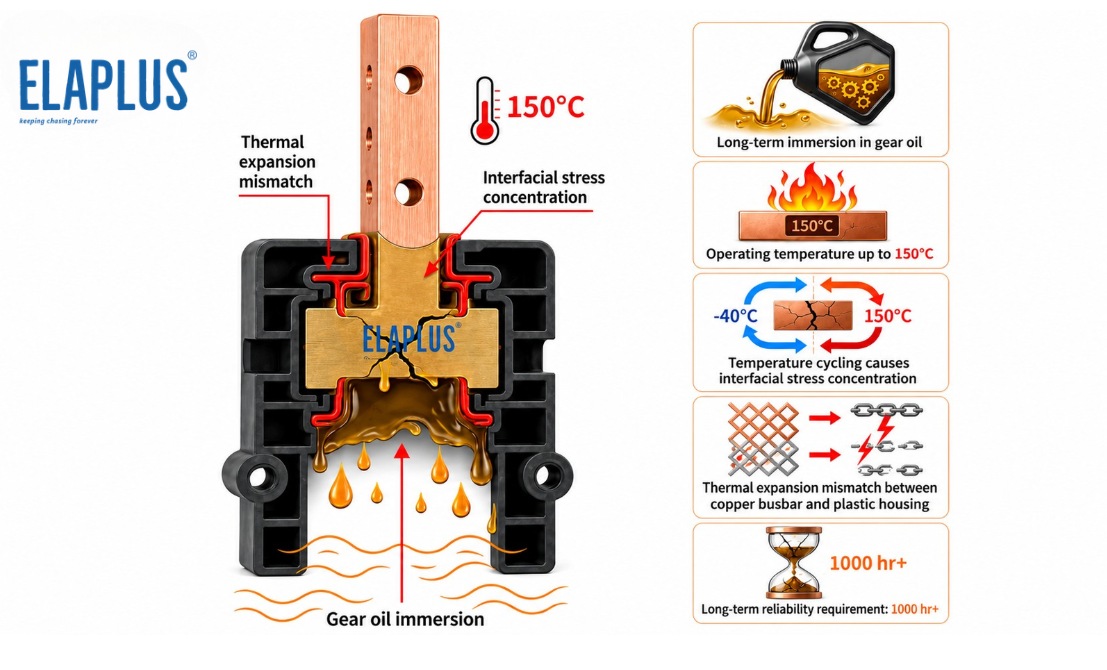
1.Flexibility: Resist cracking under thermal cycling from -40°C to +155°C
2. Oil Resistance: No swelling or softening under long-term gear oil immersion
3.Adhesion: Reliably bond to both PPS plastic and copper metal heterogeneous interfaces
II. Why All Traditional Solutions Failed
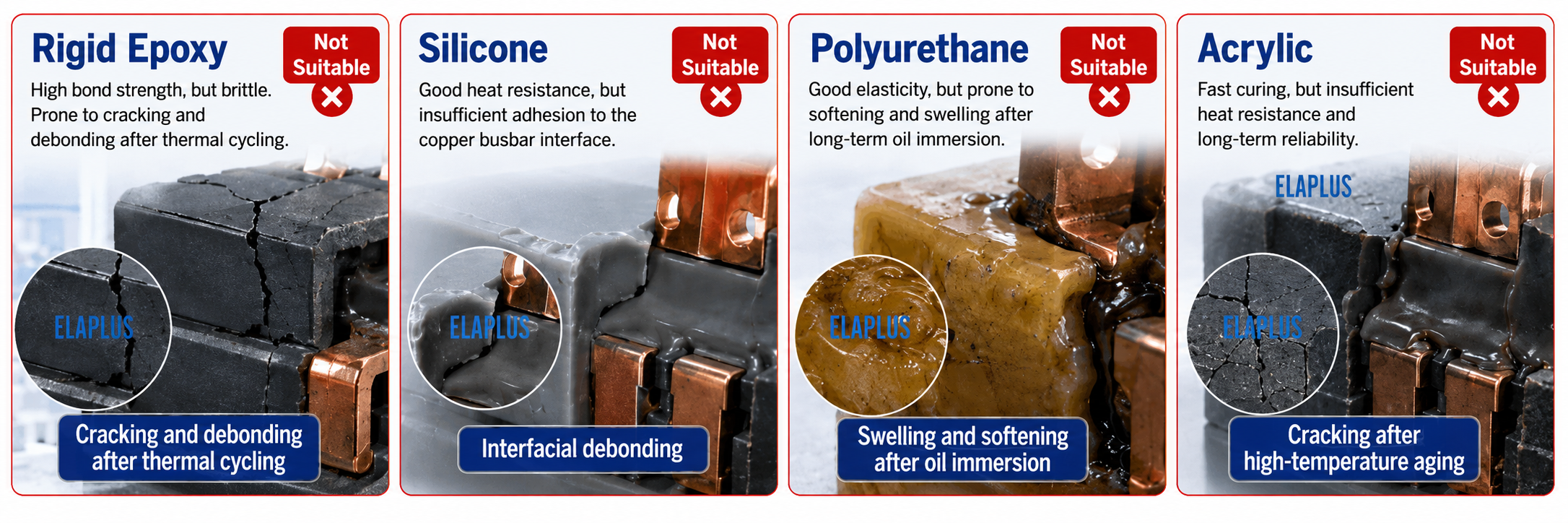
Before EP 1721-1, the industry relied on four main types of sealing materials, each with fundamental flaws:
| Material Type | Flexibility | Oil Resistance | High-Temp (150°C) | Heterogeneous Adhesion | Overall Verdict |
| Rigid Epoxy | ✗ High modulus | ✓ Solvent-resistant | ✓ Good heat resistance | ✓ Good metal adhesion | Cracks inevitably during thermal cycling |
| Silicone | ✓ Flexible | F80000 | ✓ Wide temperature range | ✗ Weak adhesion | Eroded by oil |
| Polyurethane (PU) | ✓ Flexible | ✗ Hydrolysis/oil degradation | ✗ Insufficient heat resistance | ✓ Good adhesion | Fails at high temperatures |
| Acrylic | ✓ Flexible | ✗ Solvent-sensitive | ✗ Low Tg | ✓ Good adhesion | Poor long-term durability |
| EP 1721-1 | ✓✓ | ✓✓ | ✓✓ | ✓✓ | ✓✓ Meets all requirements comprehensively |
The core contradiction: In traditional material systems, flexibility and oil resistance are inversely related — the softer the resin, the looser its molecular chains, making it easier for oil molecules to penetrate. This fundamental law of materials science was the insurmountable barrier for all conventional solutions.
III. Three Core Technological Breakthroughs of EP 1721-1
Breakthrough 01: Reconciling Flexibility and Oil Resistance
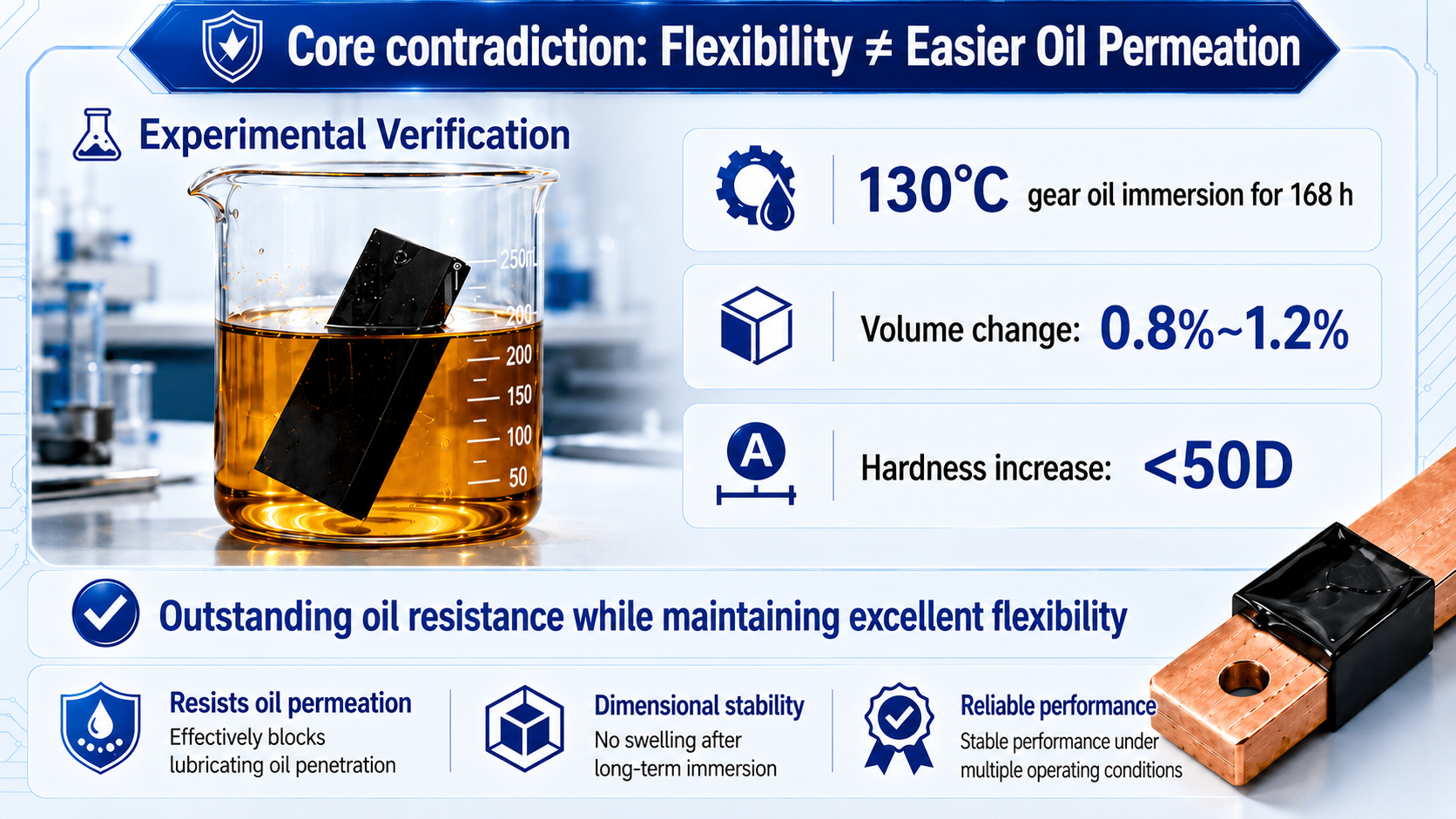
Traditional Paradox: “The softer the resin, the looser the molecular chains, the easier oil penetration, the worse the oil resistance.”
Verified Performance: After 168 hours of immersion in gear oil at 130°C, the volume change rate is only 0.8%~1.2%, and hardness increases by merely 3~5 Shore A.
Breakthrough 02: High-Reliability Adhesion to Heterogeneous Materials
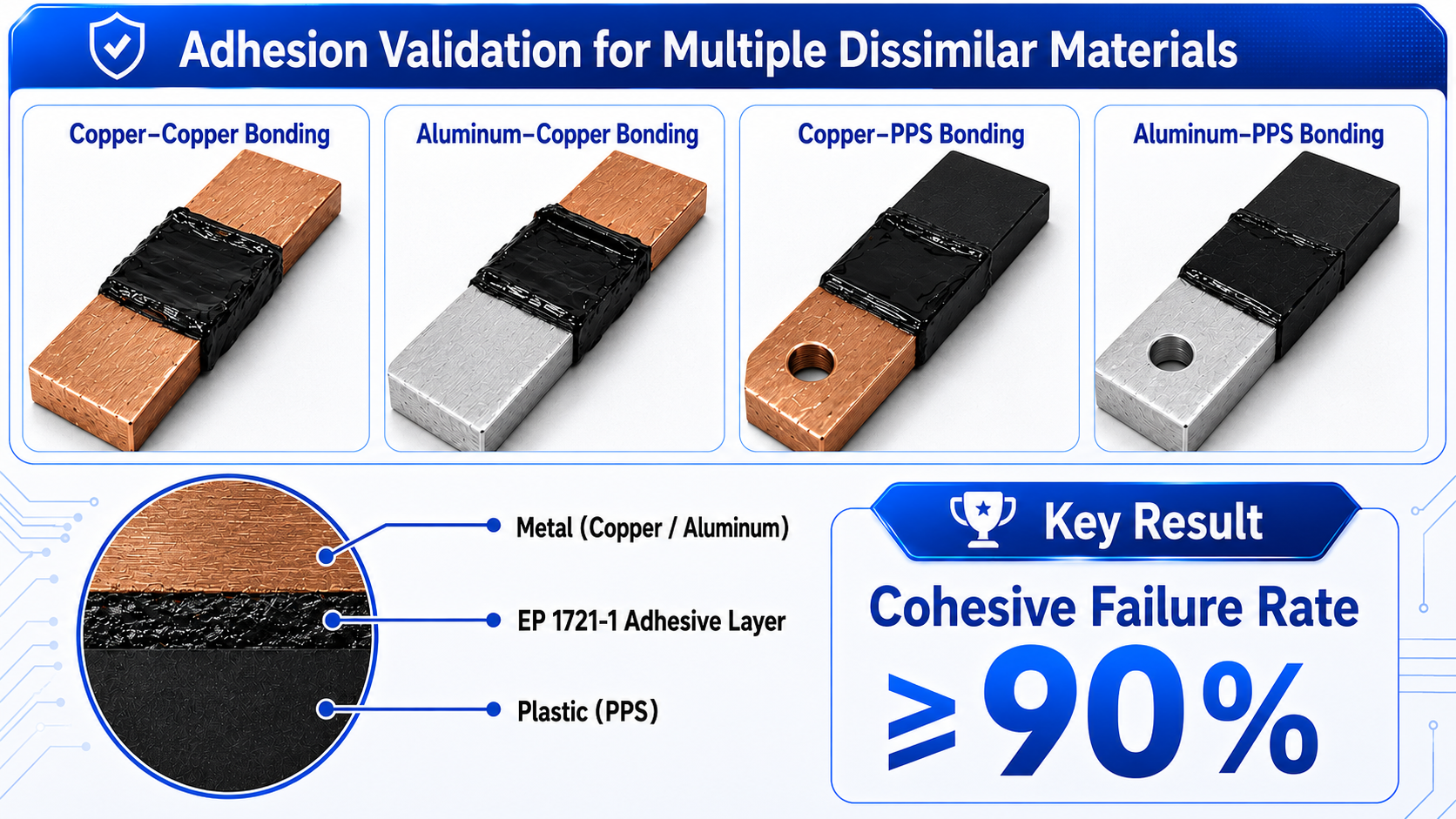
Dual Challenges: Unstable oxide layers on metal surfaces | Low surface energy and high crystallinity of plastics, which hinder adhesion.
Solution: Dual-functional interface enhancement technology, achieving a cohesive failure rate of over 90% for both adhesive-metal and adhesive-plastic bonds.
Breakthrough 03: Adhesion Durability Under Extreme Thermal Cycling
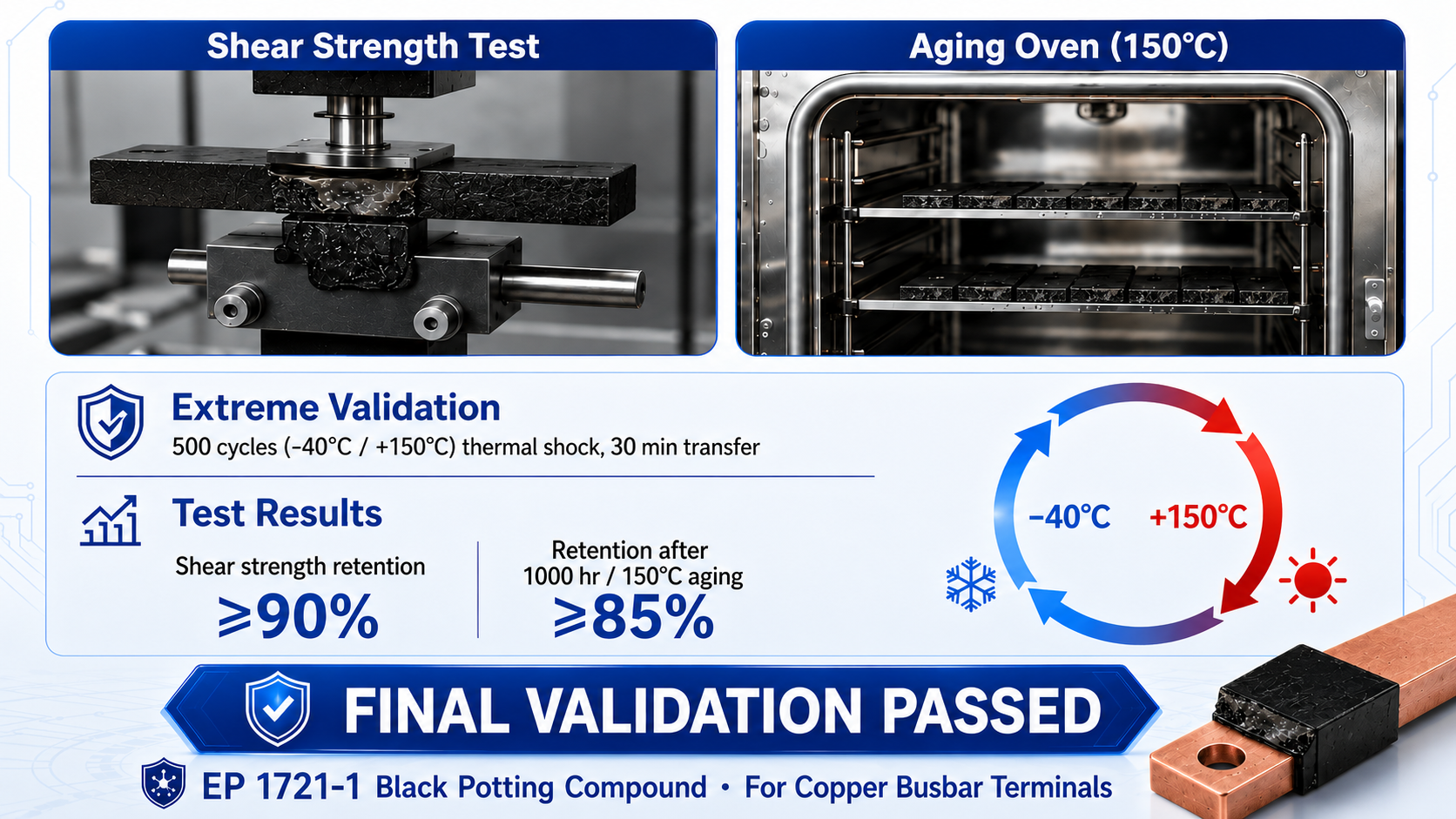
Extreme Validation: 500 thermal shock cycles (-40°C / +150°C) with 30-minute temperature transitions.
Test Results: Shear strength retention ≥90% after cycling; ≥85% retention after 1000 hours of aging at 150°C.
IV. Extreme Validation: Lubricant Oil | 150°C / 1000 Hours
Long-term reliability of sealing materials is a critical concern in the NEV industry. We subjected EP 1721-1 to the industry’s most rigorous accelerated aging test:
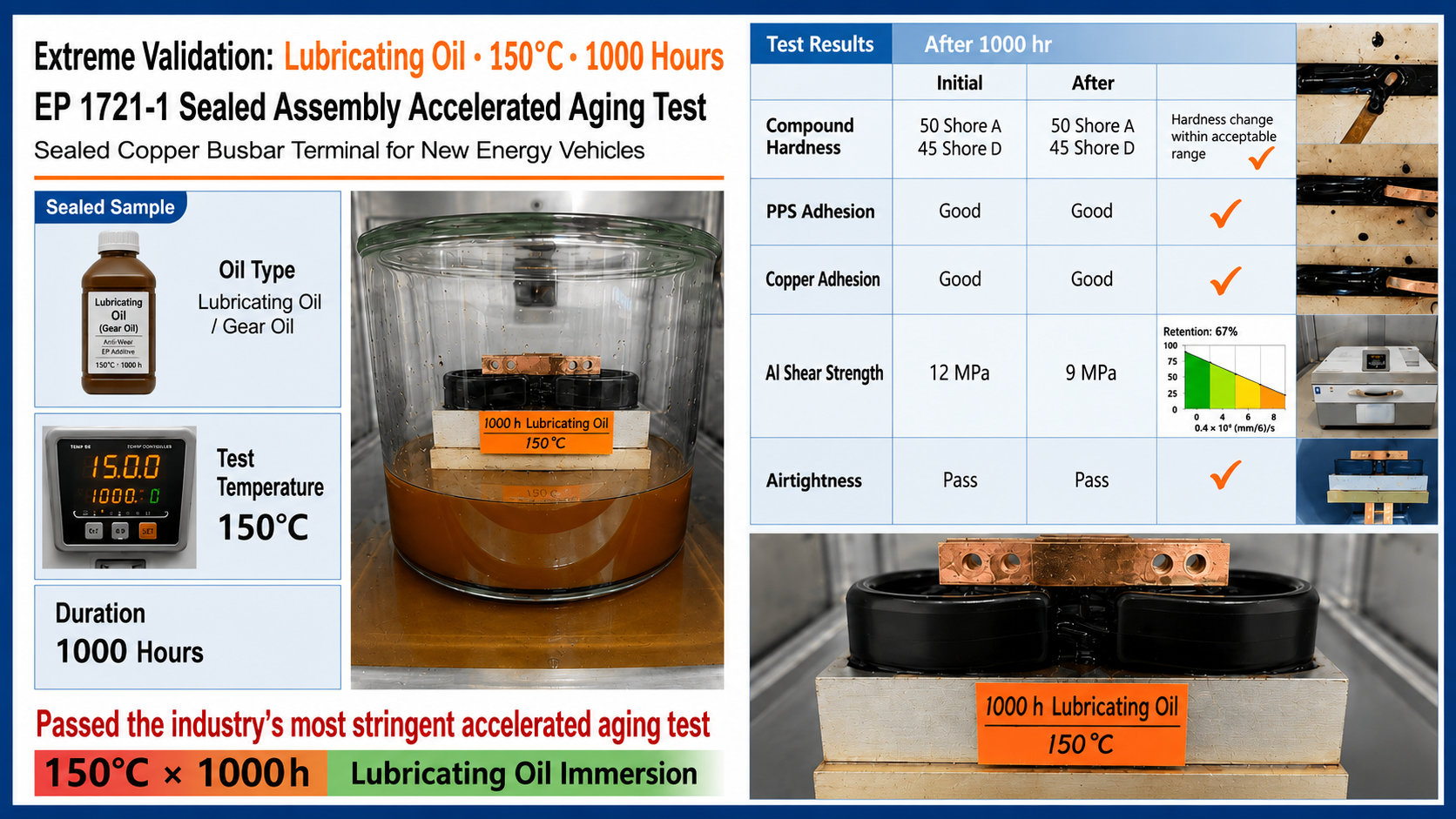
Test Conditions
| Oil Type | Lubricant / Gear Oil | Test Temperature | 150°C |
| Duration | 1000 Hours | Test Subject | Copper Busbar Connector Sealant |
Test Results
| Test Item | Initial Value | After 1000 Hrs | Verdict |
| Compound Hardness | Shore A 50 | Shore D 45 | ✓ Hardness change within acceptable range |
| Adhesion to PPS | Good | Good | ✓ Maintained |
| Adhesion to Copper | Good | Good | ✓ Maintained |
| Aluminum Shear Strength | 12 MPa | 9 MPa | ✓ 75% strength retention |
| Air Tightness | Pass | Pass | ✓ Fully sealed |
V. Product Technical Specifications
| Mixing Ratio | A:B = 3:1 (by weight) | Mixed Viscosity | 6,000-10,000 mPa·s |
| Curing Conditions | 100°C/2hr or 80°C/4hr | Cured Hardness | Shore A 40-60 |
| Tensile Strength | 3.2 MPa | Elongation at Break | 60-120% |
| Shear Strength | 2.6 MPa (Fe-Fe) | Operating Temperature | -40°C ~ 155°C |
VI. Conclusion & Industry Significance
The launch of EP 1721-1 breaks the long-held industry belief that “flexibility and oil resistance are mutually exclusive.” It provides a true engineering solution for copper busbar connector sealing in NEV electric drive systems, meeting the three core requirements of flexibility, oil resistance, and adhesion simultaneously.
From an industry perspective, this breakthrough delivers three key benefits:
- Design Freedom: Engineers no longer need to compromise between flexibility, oil resistance, and adhesion — the sealing design window is significantly expanded.
- Enhanced Reliability: Adhesion and sealing performance are fully maintained after extreme aging (1000 hr / 150°C / lubricant oil), outperforming all existing solutions.
- Cost Reduction: A single material meets multiple requirements, simplifying sealing structure design and production processes.