Thermal conductivity is far from the sole criterion for selecting potting materials for new‑energy‑vehicle OBC systems. Inside an on‑board charger coexist power devices, inductors, transformers, PCBs and high‑voltage connection zones. Different locations impose divergent requirements for thermal conduction, electrical insulation, flame retardancy, stress performance and flowability.
For OBC modules requiring low‑stress full potting, ELAPLUS SIPA 1850 series thermally‑conductive silicone potting compounds are recommended for evaluation. For constructions calling for a balance of flexibility and thermal performance, PUR 1680 thermally‑conductive polyurethane potting compound can be considered. For assemblies demanding high‑temperature performance and superior dimensional stability, EP 1710 epoxy potting system may be assessed according to design specifications.
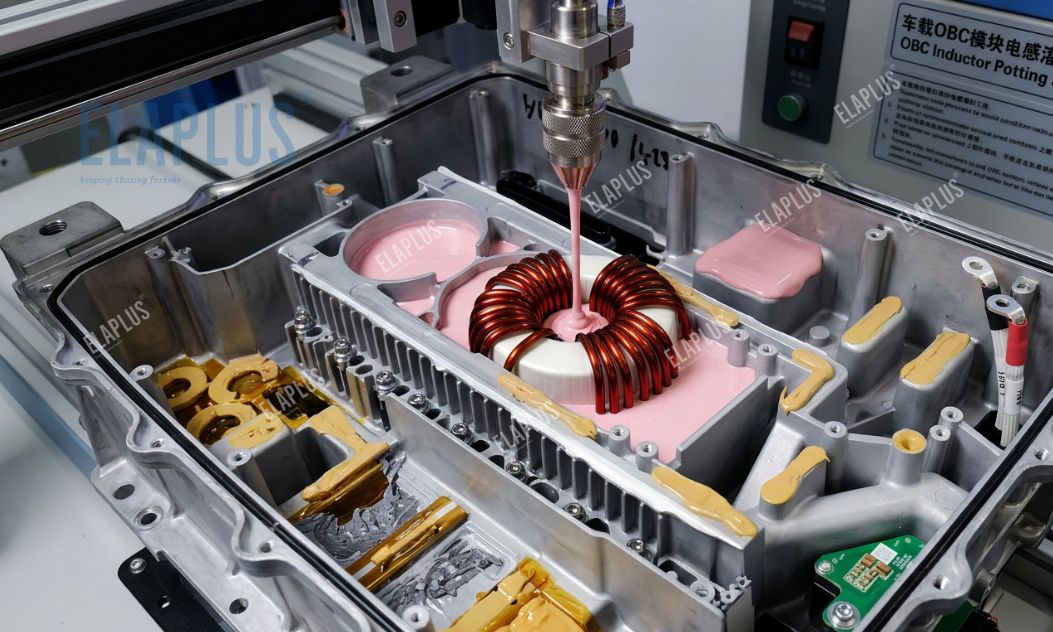
These represent the core principles for OBC electronic adhesive selection:
First define heat sources and heat dissipation paths to determine the required thermal conductivity; identify stress‑sensitive components and structural constraints to specify the target hardness of the potting material.
Why Do OBC Units Require Potting Compounds?
An On‑Board Charger (OBC) converts alternating current into direct current for vehicle traction battery packs.
As new‑energy‑vehicle high‑voltage platforms evolve and power density rises, OBC internal housings become increasingly compact, leading to concentrated heat buildup across power devices, inductors and high‑voltage circuits.
Typical field challenges include:
‑ Heat generation from inductors and transformers
‑ PCBs enduring repeated thermal cycling
‑ Vehicle‑borne vibration transmitted directly to solder joints
‑ Moisture ingress risks within high‑voltage regions
‑ Build‑up of internal stress in large‑volume potting sections
‑ Interfacial thermal resistance between power components and metal housings
OBC potting is therefore not a simple process of pouring resin into an enclosure.
Its core objectives are multi‑fold: thermal dissipation, electrical insulation, vibration resistance, moisture protection and thermal‑stress buffering.
Recommended Potting Compounds for Full‑Volume Thermally‑Conductive OBC Potting
ELAPLUS SIPA 1850
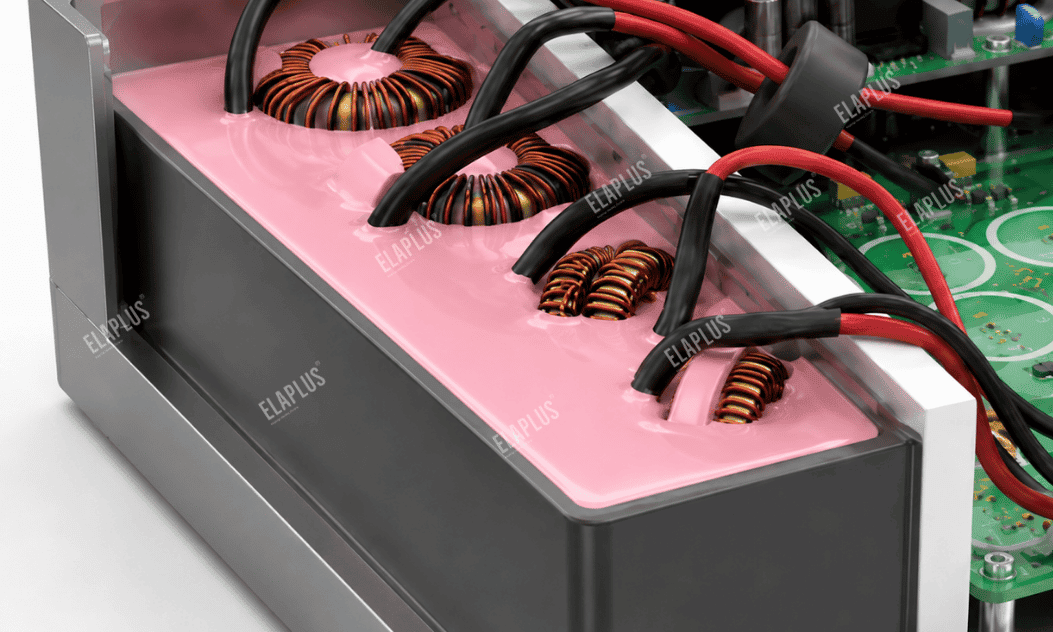
Potting for Inductors
For OBC assemblies needing low‑stress protection, the two‑component thermally‑conductive silicone potting compound SIPA 1850 series is a prime candidate.
Upon cure, this silicone‑based material retains elastic properties. It absorbs thermomechanical stress arising from differential thermal expansion and contraction across PCBs, copper, aluminum housings, ceramics and power semiconductors.
Multiple thermal‑conductivity grades are available to match thermal‑design requirements. Typical applications cover:
‑ OBC inductors
‑ PCB assemblies
‑ Power‑electronic modules
‑ Automotive controllers
‑ Full potting of power supply units
For large‑area OBC potting, beyond thermal conductivity, sufficient material flow is critical to ensure penetration into coil winding gaps, underneath PCBs, component clearances and dead corners within the housing.
Why Blind Pursuit of Ultra‑High Thermal Conductivity Is Misguided for OBC Potting
This constitutes one of the most widespread misconceptions in thermally‑conductive potting material selection.
Example:
Material A delivers 3 W/m·K thermal conductivity yet exhibits high viscosity, leaving numerous voids inside coil windings.
Material B offers 2 W/m·K thermal conductivity but flows freely to fully fill gaps between coils and enclosure walls.
In real‑world service, Material B can outperform Material A.
Air possesses extremely low thermal conductivity. Voids and entrapped bubbles create localized thermal barriers even for intrinsically high‑conductivity potting resins.
OBC potting performance depends on the combined effect of:
thermal conductivity × flowability × bond‑line thickness × bubble control × actual heat‑dissipation paths, rather than thermal‑conductivity figures in isolation (W/m·K).
Advantages of Polyurethane Potting Compounds for OBC
ELAPLUS PUR 1680
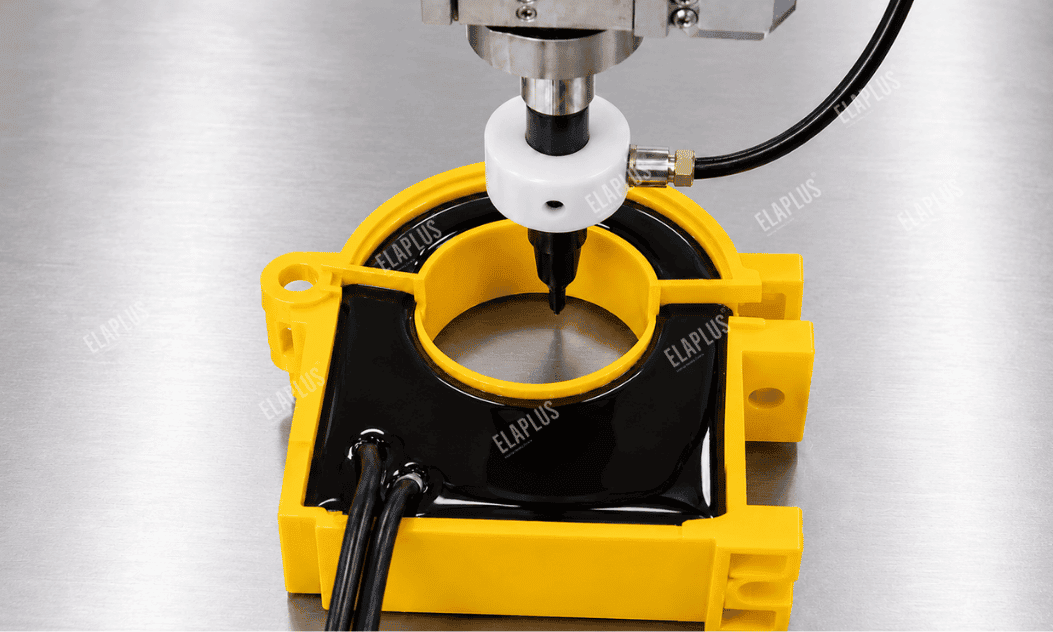
Potting for Current Sensors
PUR 1680 is suitable for assemblies that require a balanced combination of thermal conduction, flexibility, vibration resistance, moisture sealing and moderate mechanical support.
Polyurethane formulations sit between rigid epoxy and soft silicone elastomers. They are preferred for certain OBC designs where excessive hardness is undesirable, yet greater mechanical anchorage than silicone is demanded.
Why Evaluate Epoxy for High‑Temperature OBC Potting
ELAPLUS EP 1710
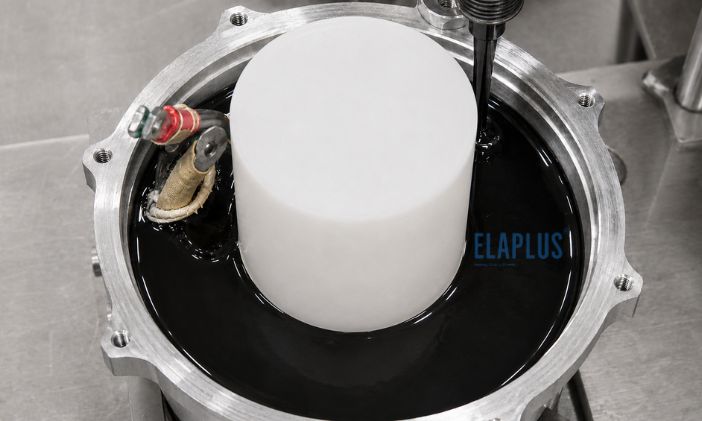
Motor‑grade Potting Compound
EP 1710 is an epoxy‑based potting grade intended for applications requiring:
‑ High dimensional stability
‑ Low coefficient of thermal expansion (low CTE)
‑ High‑temperature electronic encapsulation
‑ High‑voltage insulation
‑ Structural mechanical support
When deploying epoxy for large‑volume OBC potting, special attention must be paid to material modulus. Avoid overly high hardness specifications when sensitive components are exposed to mechanical stress.
Quick‑Selection Guide for OBC Thermally‑Conductive Potting Compounds
| Application Requirement | Recommended Grade |
|---|---|
| Low‑stress full‑module potting | SIPA 1850 |
| Wide‑range thermal‑cycling endurance | SIPA 1850 |
| Flexibility plus mechanical reinforcement | PUR 1680 |
| High‑temperature dimensional stability | EP 1710 |
| High‑heat‑generating inductors (high‑thermal‑conductivity variant) | SIPA 1850 high‑conductivity grade |
| Thermal interface cooling for power devices | TCMP thermal‑gap‑filler gel series |
FAQ – Frequently Asked Questions for OBC Potting
Q: Is higher thermal conductivity always better for OBC potting compounds?
A: No. Viscosity, gap‑filling capability, bond‑line thickness, bubble suppression and real‑world heat‑dissipation pathways must also be factored in.
Q: Why are low‑stress potting materials preferred for OBC?
A: PCB, copper, aluminum, ceramic and other constituent materials feature dissimilar coefficients of thermal expansion. Rigid high‑volume potting transfers thermally‑induced mechanical stress onto solder joints and electronic components.
Q: Should the entire OBC housing be fully filled with potting resin?
A: This depends on mechanical design. Some units adopt full potting; others use partial potting or thermal‑interface gap filling.
Q: What causes bubble formation during OBC potting?
A: Common root causes include air entrapment during mixing, trapped air within coil windings, excessive viscosity, overly fast dispensing rates and inadequate degassing processes.
ELAPLUS | Original Manufacturer | Application‑engineering Support | Free Sample Requests
📧 info@elaplus.cc
🌐 www.elaplus.cc