ELAPLUS SIPC 1928 silicone thermal conductive adhesive sealant may be evaluated for thermal bonding and fixation of power transistors, thyristors and other heat‑generating components mounted on PCBs of industrial power supplies. Key verification targets include the component heat transfer path, mechanical positioning method, adhesive curing regime and electrical clearance. For industrial power supplies fitted with aluminium or copper heat sinks, thermal bonding adhesive can deliver auxiliary fixation and heat transfer at qualified locations, yet it shall not replace mechanical fasteners or dedicated electrical insulation structures without prior qualification.
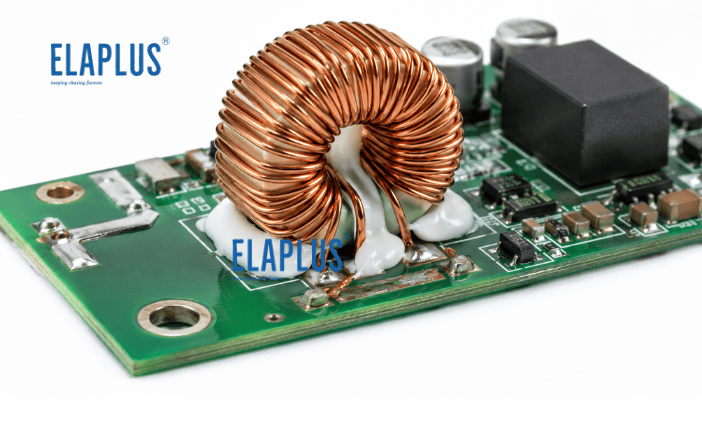
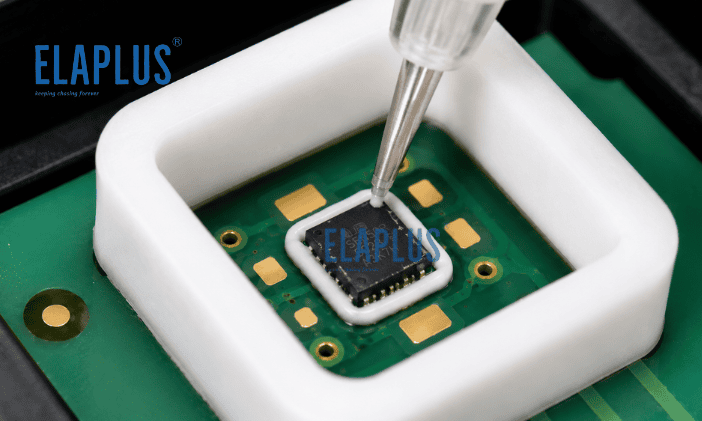
Industrial power supplies generally incorporate switching devices, rectifiers, inductors, capacitors and control PCBs. Certain power semiconductors continuously generate heat during operation, which must be dissipated to the ambient via heat sinks, metal baseplates or comparable structures. One‑component thermal silicone adhesives offer convenient processing for components requiring local retention and supplementary heat dissipation. Nevertheless, material selection depends not merely on thermal conductivity; rational adhesive placement, full cure and structural endurance against transit and operating loads must also be confirmed.
1. Why Power Components in Industrial Power Supplies Require Thermal Fixation
Heat from power semiconductors inside industrial power supplies travels through the package, metallic thermal interface and heat sink. Poor interfacial contact between the component and heat dissipation hardware degrades overall thermal transfer. In selected designs, thermal bonding adhesive can locate parts, provide local retention or fill controlled gaps between devices and designated metal substrates. Components subject to high mechanical loads shall retain screws, spring clips or other robust fastening schemes.
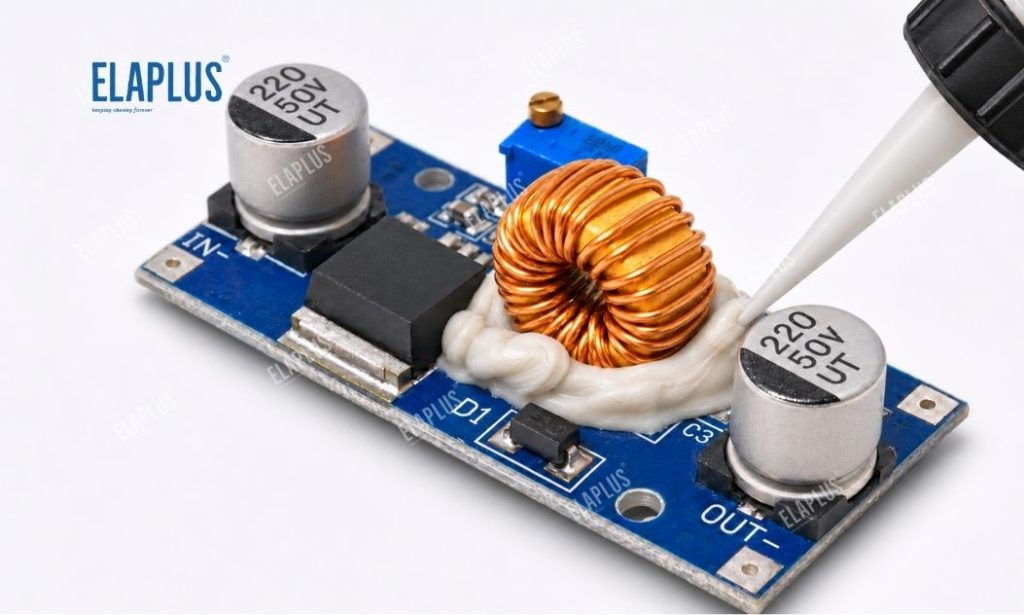
A clear distinction must be drawn between thermal structural adhesive and ordinary thermal grease. The former cures into an elastic layer with measurable bonding strength, while thermal grease functions primarily as an interface filler and cannot serve as a standalone structural fastener. If the primary thermal path of a power device relies on specialised insulating gaskets, ceramic substrates or other interfacial components, direct substitution with thermal adhesive is prohibited without redesign.
2. Evaluating Adhesive Requirements for Different Components in Industrial Power Supplies
| Bonding Location | Core Engineering Requirements | Priority Inspection Items | Recommended Material Category |
|---|---|---|---|
| Power devices and qualified metal substrates | Heat transfer and auxiliary positioning | Electrical isolation, adhesion, bond line thickness | Thermal conductive adhesives such as SIPC 1928 |
| Perimeter retention of rectifiers | Mechanical stability and supplementary heat dissipation | Device package, loading mode | Flexible thermal fixation adhesive |
| Bottom mounting of large capacitors | Vibration resistance and mechanical retention | Mass, vibration, stress on bond line | Qualified flexible mounting adhesive |
| Small heat sinks and electronic assemblies | Heat transfer and local interconnection | Bond area, operating temperature | Thermal conductive bonding materials |
| Power devices and standalone heat sinks | Stable contact and heat transfer | Clamping force, electrical insulation | Dedicated TIM paired with mechanical fastening |
| Large electronic enclosures | Thermal conduction, insulation and bulk protection | Potting volume, stress and serviceability | Qualified thermal potting adhesive |
For large capacitors where vibration resistance is the dominant demand, mechanical reliability takes precedence. A high thermal conductivity rating alone does not justify prioritising thermal adhesive. For power devices involving safety insulation, adhesive suitability shall be judged by full insulation qualification testing.
3. Why Thermal Conductivity Is Not the Sole Comparison Metric
Thermal conductivity quantifies a material’s intrinsic heat conduction capacity, yet the actual temperature rise of a power device is jointly determined by heat generation, contact area, heat sink performance and ambient airflow. Where thermal adhesive is applied only for partial auxiliary fixation on sidewalls or bottom edges, it must be confirmed whether the bond line lies on an effective thermal path. Even high‑conductivity adhesive fails to reduce component temperature if it does not bridge the heat source and dissipation structure.
Furthermore, cure performance and structural loading govern retention. Components experience inertial loads during shipment and vibration; insufficient bonding area or weak adhesion to the substrate compromises fixation. Accordingly, material selection shall consider heat transfer, interfacial bonding, curing mechanism and electrical clearance concurrently.
4. Why ELAPLUS SIPC 1928 Thermal Silicone Adhesive Is Recommended
ELAPLUS SIPC 1928 is a one‑component neutral alkoxy‑cure silicone thermal conductive adhesive sealant that cures upon exposure to ambient moisture and forms an elastic rubber matrix after cross‑linking. Supplied as a white paste, it combines thermal conduction, electrical insulation and elastic cushioning. It may be assessed for positioning of PCB electronic components, thermal interconnection between power devices and qualified metal substrates, as well as sealing and retention of selected electronic assemblies.
For eligible power devices on industrial power supply boards, SIPC 1928 integrates local bonding fixation and heat transfer requirements. For assemblies combining metal and plastic, performance shall be validated against substrate adhesion and thermal cycling.
As a moisture‑cure system, its curing progress is affected by bond geometry, ambient humidity, temperature and exposed surface area. Deep enclosed gaps or fully impermeable thick sections cannot be assumed to cure uniformly from surface to core.
ELAPLUS: Match adhesives to working conditions, rather than overemphasising nominal parameters. Thermal fixation for industrial power supplies requires alignment between material properties, actual thermal paths, structural loads and process constraints.
5. Selection between SIPC 1928 and Alternative Thermal Materials
| Candidate Material | Material System | Key Features | Primary Evaluation Direction |
|---|---|---|---|
| SIPC 1928 | One‑component thermal silicone adhesive | Moisture cure, elastic bonding | Local auxiliary fixation for power devices |
| SIPC 1919 | One‑component thermal silicone adhesive | Thermal conductivity: 2.0 W/m·K | Thermal bonding of electronic components |
| SIPC 1857 | One‑component thermal silicone adhesive | Thermal conductivity: 0.8 W/m·K | PCB component fixation and thermal coupling |
| SIPA 1850‑40 | Two‑component thermal potting silicone | Thermal conductivity: 4.0 W/m·K | Thermal potting of qualified power enclosures |
| TCMP 1941 | Two‑component thermal gel | Thermal conductivity: 4.02 W/m·K | Gap filling between heat sources and dissipation structures |
These materials are not interchangeable. SIPC 1928 targets structural bonding at qualified locations; SIPA 1850‑40 is designed for potting protection, while TCMP 1941 serves as a compliant thermal gap filler. Selection shall follow functional differentiation.
For heat sink assemblies requiring disassembly or repair, demoulding methods and rework cost shall be evaluated in advance. If bonding is unnecessary for the application, non‑adhesive thermal interface materials may be preferable.
6. Dispensing Process Design for Thermal Fixation Adhesive in Industrial Power Supplies
Prior to dispensing, confirm component packaging, PCB layout, heat sink material and permitted dispensing zones. Inspect for exposed high‑voltage conductors, test points, removable fasteners and electrical contact zones that must remain clean around power devices.
For local fixation, bead geometry may be designed according to component mass, bonding footprint and assembly clearance, though adhesive trails shall not be laid across unvalidated high‑voltage insulation boundaries. Dot or strip dispensing must achieve reliable contact with both mating substrates.
Since SIPC 1928 cures via moisture uptake, cure duration shall be defined by bond thickness and vapour permeability of the interface. Skin formation on the surface does not guarantee full through‑cure, and cure schedules for other silicone products cannot be copied directly.
For automated dispensing lines, control nozzle position, shot volume and bead dimension. First‑article validation and periodic sampling are required to maintain consistency.
7. Qualification Tests for the Actual BOM
Complete test assemblies shall be fabricated using production‑representative PCBs, power devices, metal heat sinks and SIPC 1928. Substrate adhesion shall be verified first, followed by assessment of adhesive placement, cure completeness and post‑assembly electrical clearance.
Thermal qualification shall run under specified input voltage, output load and ambient temperature, logging temperatures of critical power devices and heat sinks. Control samples without adhesive may be included alongside alternative dispensing layouts to verify whether the bond line participates in effective heat transfer.
Mechanical validation shall replicate component weight, mounting orientation, shipping conditions and equipment vibration specifications. For industrial power supplies subject to long‑term thermal cycling, post‑test inspection shall cover bonding interfaces, electrical insulation and structural stability.
Recurring failures at the same component point to local geometry and load paths; random defects across batches indicate issues with material storage, surface preparation, shot volume control or curing conditions.
8. Adaptation for Different Industrial Power Supply Scenarios
Industrial switching power supplies adopt defined thermal management architectures between power semiconductors and heat sinks. SIPC 1928 may be evaluated for auxiliary local retention, provided mandatory insulation and fastening measures are retained.
Power supplies for communications equipment feature high component density; clearances from adhesive to connectors, hot‑swap modules and service zones must be tightly controlled, alongside long‑term material stability and steady‑state component temperature rise.
For auxiliary power units in new‑energy vehicles and other high‑vibration equipment, the interaction between adhesive fixation and mechanical supports shall be characterised. No safety‑critical retention application shall approve material substitution solely based on initial peel tests.
FAQ
Q: Can thermal silicone adhesive be used to fix power devices in industrial power supplies? A: SIPC 1928 may be evaluated for qualified structures, subject to validation of bonding, heat dissipation and electrical safety requirements.
Q: Is SIPC 1928 one‑component or two‑component? A: It is a one‑component moisture‑cure silicone thermal conductive adhesive sealant.
Q: Can thermal bonding adhesive replace thermal grease? A: Direct replacement is not permissible. They differ in curing behaviour, structural function and rework characteristics.
Q: Will dispensing adhesive on power devices definitely lower temperature rise? A: Not necessarily. Confirmation relies on placement on an effective thermal path and full assembly temperature testing.
Q: Can SIPC 1928 be applied directly at high‑voltage insulation locations? A: Electrical insulation rating alone is insufficient; actual structural creepage distance and withstand voltage requirements must be validated.