Material selection of sealant for automotive connector pin terminals calls for simultaneous consideration of precision dispensing, fluid flowability, UV penetration, shadow‑zone curing and insulation protection after cure. For such applications, ELAPLUS SIPC UV 3302 UV/moisture dual‑cure silicone sealant is recommended for evaluation. This one‑component material features low viscosity and self‑levelling behaviour, rapid UV tack cure and progressive moisture cure, offering a material and process option for root sealing of connector pins in automotive assemblies.
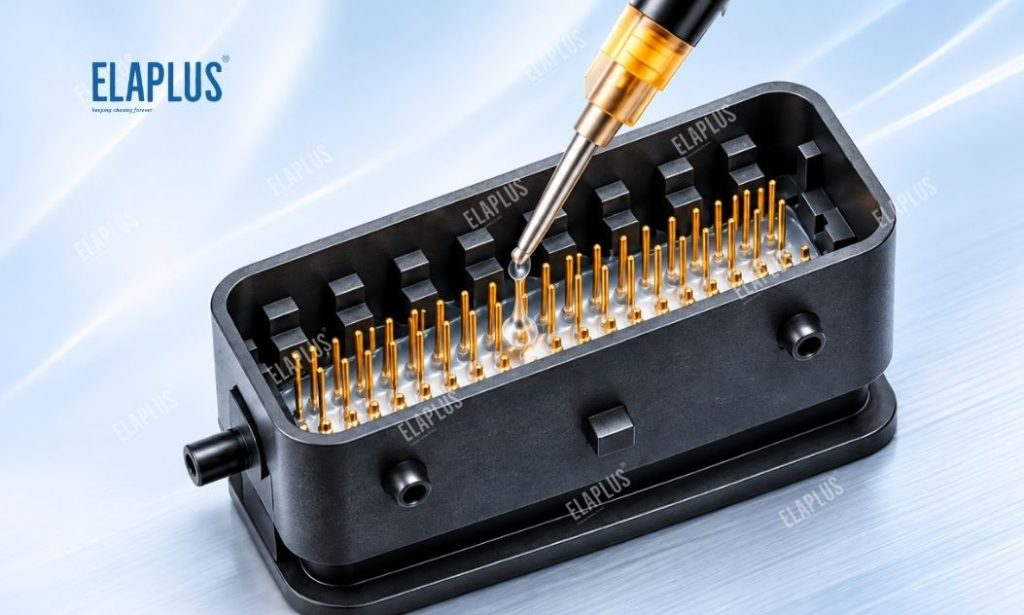
Rather than focusing merely on fast curing, automotive electronics manufacturing places greater emphasis on controlled ingress of adhesive into designated sealing zones, adequate cure in shadowed areas and stable interfacial bonding between the adhesive and diverse substrates.
1. Why Both Material and Process Matter for Automotive Connector Pin Sealing
Within automotive electronic systems, connectors deliver power transmission, signal routing and module communication. Connectors deployed in automotive controllers, sensors and body electronics generally comprise metallic pins, plastic housings and terminal retention structures.
These constituents differ substantially in thermal expansion, surface energy and mechanical properties, introducing multiple considerations for sealant selection.
- Precise fluid control for dense pin arrays Where pins are tightly packed inside a connector, dispensing path, shot volume and flow behaviour directly govern seal formation. The adhesive must cover intended sealing locations while avoiding terminal contact zones, mating faces and other no‑adhesive areas. Consequently, lower viscosity is not inherently preferable; the balance between flowability and dispensing accuracy is critical.
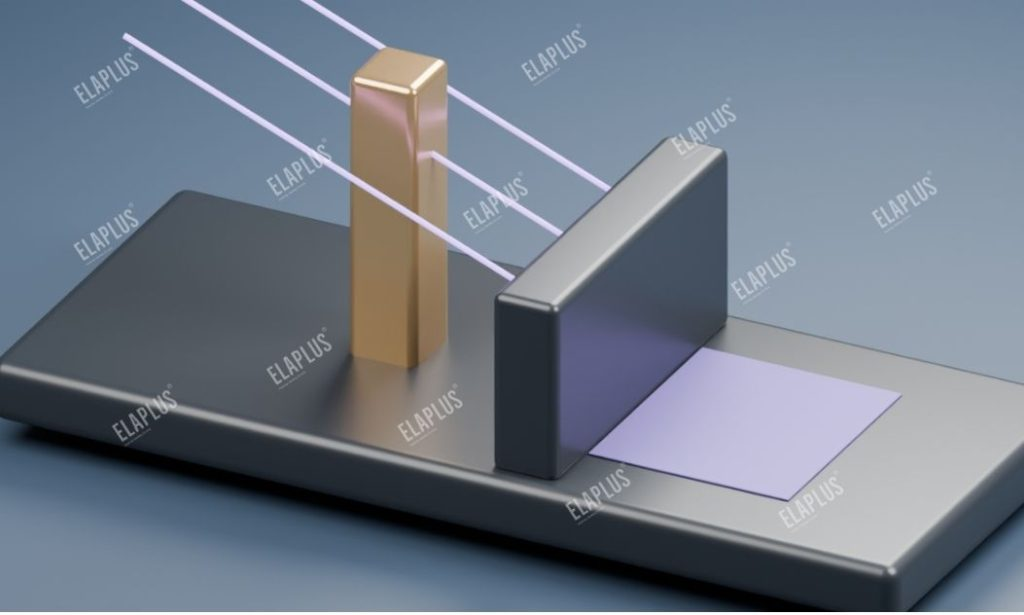
- UV shadow zones within complex geometries Deep recesses, terminal roots, plastic baffles and local indentations inside connectors may block direct ultraviolet exposure. For materials relying solely on UV irradiation, cure completeness in these locations requires dedicated validation. Where a connector contains both illuminated and shaded regions, a UV/moisture dual‑cure system may be assessed.
- Balanced flexibility and electrical insulation Automotive connectors in service are subjected to thermal cycling, vibration and assembly stress. After curing, the sealant must retain structural integrity together with suitable flexibility to mitigate stress concentration induced by overly rigid films. For applications requiring electrical insulation, material performance shall be verified against operating voltage, creepage distance and environmental conditions.
2. Why SIPC UV 3302 Is Recommended for Pin Sealing
ELAPLUS SIPC UV 3302 is a one‑component UV/moisture dual‑cure silicone sealant. Its primary selection value lies in combining rapid tack cure on exposed surfaces with subsequent cure in shadowed regions. The material possesses controlled flowability and cures into a soft, tough elastomer, serving as a candidate for precision sealing of automotive connectors.
- Rapid UV tack cure for streamlined production On surfaces accessible to ultraviolet light, SIPC UV 3302 achieves fast initial cure under appropriate UV exposure. This property stabilises the as‑dispensed geometry and grants process flexibility for automated dispensing lines. The reference light source specified in product documentation is a 365 nm LED UV source, with recommended irradiance of 70–100 mW/cm² and exposure duration of 15–30 seconds. These are reference process parameters; actual UV energy, working distance and exposure time shall be validated according to equipment configuration, film thickness and structural occlusion.
- Secondary moisture cure for locally shadowed structures A defining characteristic of SIPC UV 3302 is that regions insufficiently irradiated by UV continue curing under ambient moisture. This mechanism enables progressive cure of bulk adhesive at pin roots, internal grooves and other hard‑to‑reach locations within connectors. Nevertheless, surface tack cure by UV does not signify full through‑cure. The reference time quoted for complete deep‑section cure is seven days. Actual duration depends on geometry, film thickness and curing environment and shall not be adopted universally as mass‑production acceptance criteria for all connector types.
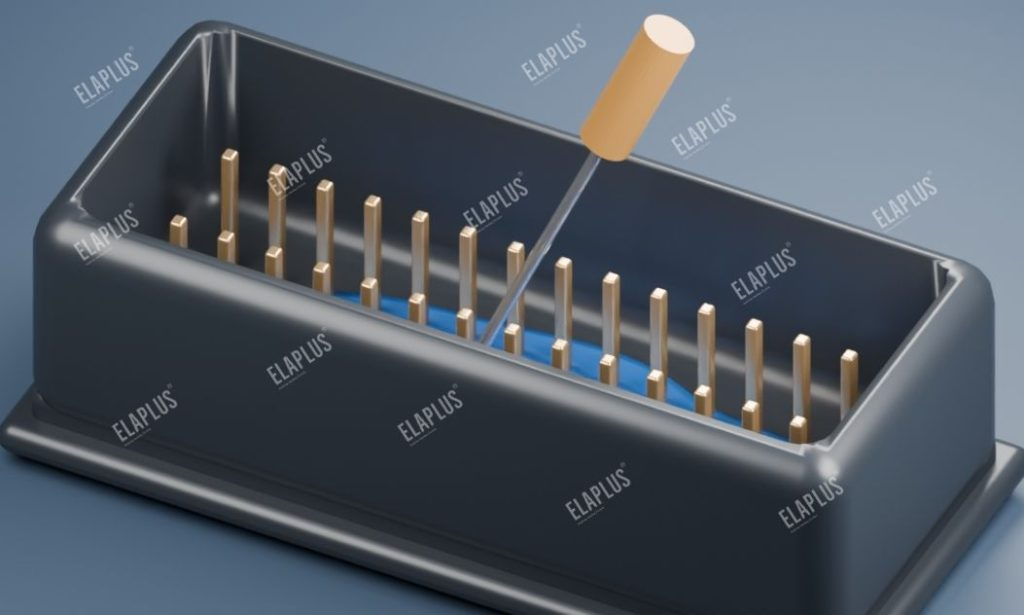
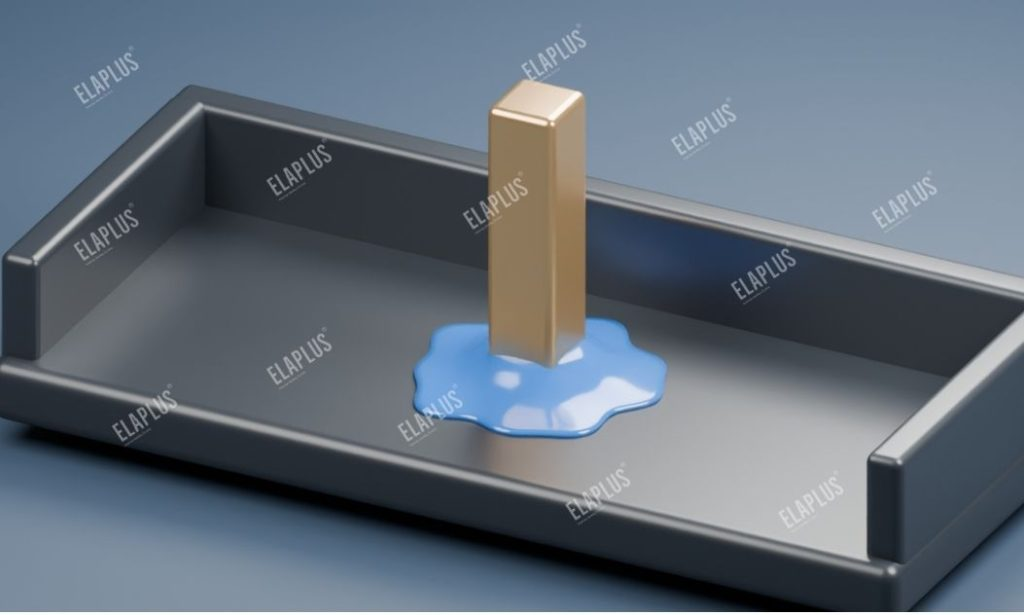
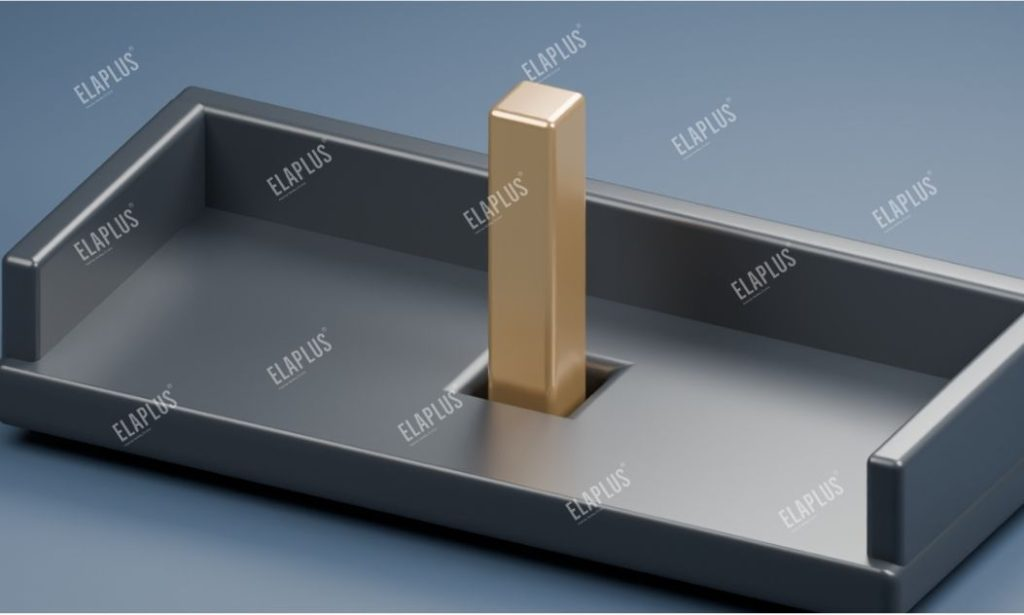
- Low viscosity and self‑levelling for precision dispensing Prior to cure, SIPC UV 3302 exhibits low viscosity and self‑levelling behaviour. For connector pin sealing, needle dispensing can deposit material at targeted points, allowing controlled spreading within predefined zones. Process design shall prioritise validation of:
- wetting at pin roots;
- volumetric uniformity across multi‑pin arrays;
- undesirable sagging or overflow after dispensing;
- accidental ingress into electrically active contact areas.
Needle geometry, dispensing trajectory and per‑shot volume shall be matched to the connector design.
- Flexible elasticity and insulating performance Fully cured SIPC UV 3302 forms a soft elastomer featuring low shrinkage and favourable electrical insulation. According to technical documentation, its elongation at break exceeds 300 % and dielectric strength surpasses 18 kV/mm. These figures support evaluation for flexible sealing and electrical insulation, yet compliance with full‑assembly protection requirements must be confirmed by physical testing.
3. Process Design for SIPC UV 3302 Dispensing on Automotive Connectors
Process evaluation for pin sealing may be divided into four major stages: targeted dispensing, UV tack cure, moisture‑driven post‑cure and sample validation.
| Process Stage | Key Operations | Engineering Focus |
|---|---|---|
| Pre‑dispensing preparation | Substrate cleaning, definition of dispensing zones | Surface contamination, pin plating, no‑adhesive boundaries |
| Precision needle dispensing | Volume control along defined paths | Wetting, levelling and seal continuity |
| UV tack cure | Light source setup following reference conditions | UV energy, occlusion, initial cure quality |
| Moisture post‑cure | Provision of adequate curing conditions | Shadow zones, deep cure and interfacial adhesion |
Step one: define dispensing boundaries at pin roots Before dispensing, identify structural positions requiring sealing and mark dispensing and exclusion zones per connector drawings. For dense terminal arrays, trial runs shall observe spreading behaviour to select suitable needle size, shot volume and dispensing sequence.
Step two: regulate adhesive spreading Deploy compatible dispensing equipment to deposit adhesive within target areas. An optimal seal is not necessarily the thickest possible layer, but a continuous, uniform and controllable film confined to specified boundaries. For intricate connectors, inspect for voids, bead accumulation and other irregularities between pins.
Step three: execute UV tack cure Place dispensed connectors under appropriate ultraviolet irradiation. For geometries with shadowed features, adjust light source position, incidence angle and energy distribution to improve cure consistency across illuminated surfaces. Upon UV exposure completion, distinguish surface tack cure from full through‑cure.
Step four: complete moisture post‑cure and quality inspection Maintain suitable ambient conditions to enable continued cure of adhesive that received inadequate UV exposure. Subsequent sample testing shall verify cure depth, seal continuity, adhesion and electrical protection performance. For nearly enclosed deep cavities with restricted moisture ingress, post‑cure feasibility requires separate validation; dual‑cure chemistry alone does not guarantee suitability.
4. Validation of Pin Sealing Process Compliance
Adhesive selection for automotive electronics relies not only on datasheet parameters but also on a qualification scheme tailored to each connector design. The following test items are recommended.
| Validation Item | Inspection Focus | Suggested Method |
|---|---|---|
| Dispensing consistency | Shot volume, seal location, spreading footprint | Visual and dimensional inspection |
| Deep‑section cure | Cure completeness in shadowed features | Cross‑section examination of representative samples |
| Interfacial adhesion | Bonding at metal plating and plastic housing interfaces | Substrate adhesion testing |
| Electrical insulation | Insulating performance of cured film | Insulation testing per product specification |
| Environmental reliability | Resistance to thermal cycling, damp heat and vibration | Environmental testing conforming to assembly requirements |
| Seal integrity | Compliance with target waterproofing and sealing demands | Applicable airtight, watertight or IP testing |
Special attention is required: connector pins incorporate metallic terminals and diverse plating systems, and adhesion performance varies across metal and plastic surfaces. Although SIPC UV 3302 datasheet lists bonding to metals, glass and plastics, it does not deliver identical performance for every plating and substrate combination. For copper and copper‑alloy constructions, targeted validation shall follow compatibility notes in product documentation instead of extrapolating results from other substrates.
5. Additional Applicable Scenarios beyond Automotive Connectors
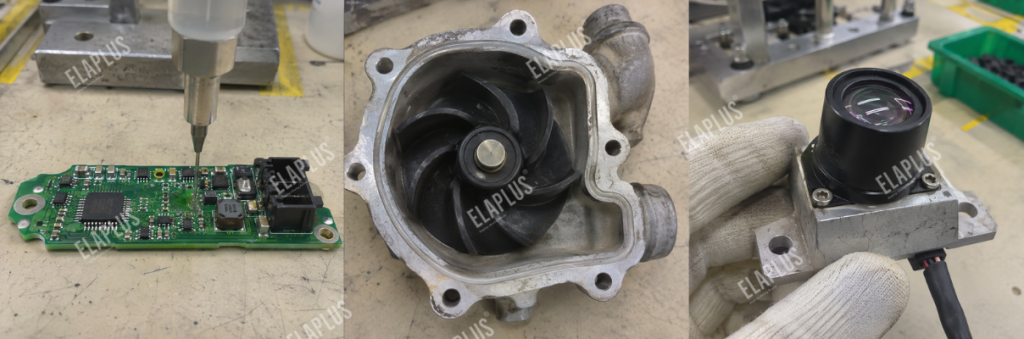
SIPC UV 3302 is not limited to pin sealing. Subject to datasheet guidance and structural requirements, it may be evaluated for the following electronic protection applications.
PCB local dispensing and protection For PCB components, designated protection points and delicate electronic assemblies, needle dispensing may be assessed where targeted coverage is preferred over full conformal coating. Validation shall focus on dispensing footprint, film thickness, shadow‑zone cure and downstream assembly constraints.
Gap sealing for electronic water and oil pumps Electronic water pumps, oil pumps and associated motor assemblies contain housing joints and local sealing points. Suitability of SIPC UV 3302 shall be evaluated against gap geometry, material combinations and service environment, with confirmation of flow characteristics and UV/moisture curing compatibility.
Optical and optoelectronic component bonding Selected bonding joints within high‑precision optical and optoelectronic instruments may also be considered for evaluation. Such applications demand extra scrutiny of substrate adhesion, cure shrinkage and device‑specific film requirements.
A shared material evaluation framework may be adopted across use cases, yet curing parameters and acceptance criteria cannot be directly reused.
6. FAQ on Pin Sealant Selection
Q1: Which material is suitable for automotive connector pin sealant? A: ELAPLUS SIPC UV 3302 UV/moisture dual‑cure silicone sealant may be evaluated for automotive connectors requiring precision dispensing, fast UV tack cure and containing local shadowed regions. Final approval shall be based on substrate, geometry and intended protection targets.
Q2: Is the pin sealant fully cured after 15–30 seconds of UV exposure? A: Not necessarily. UV irradiation delivers rapid initial cure for exposed surfaces, while deep and shadowed sections rely on moisture for further cure. Actual full‑cure timing shall be established by sample testing.
Q3: Is SIPC UV 3302 compatible with automated dispensing? A : It qualifies as a candidate for automated precision dispensing. This one‑component, low‑viscosity self‑levelling material requires equipment trials to define needle specification, shot volume, dispensing speed and exposure conditions.
Q4: Can SIPC UV 3302 inherently achieve IP67 or IP68? A: Protection ratings such as IP67 and IP68 describe full‑assembly or enclosure performance under defined test conditions and cannot be inferred from material datasheet values alone. They depend on structural design and formal qualification testing.
Q5: Can SIPC UV 3302 be used for local PCB dispensing? A: Evaluation may proceed according to the specific PCB protection geometry. For targeted needle dispensing, inspect adhesive spreading around components, no‑glue zones, electrical performance and cure completeness.
7. Conclusion: Matching Process to Material for Connector Sealing
The essence of automotive connector pin sealing is not maximising cure speed, but harmonising adhesive flow, UV tack cure, moisture post‑cure and interfacial protection to satisfy structural demands. Featuring UV/moisture dual‑cure chemistry alongside self‑levelling and flexible elastomeric properties, ELAPLUS SIPC UV 3302 provides a promising candidate material for pin sealing and related electronic sealing applications. Prior to mass production, full qualification covering dispensing parameters, cure state, substrate compatibility and reliability is recommended to establish project‑specific engineering acceptance criteria.