In automotive electronic systems, the Mass Air Flow (MAF) sensor can be regarded as the engine’s respiratory monitor. It real-time measures the intake air flow and provides critical data for the ECU to precisely calculate fuel injection quantity. Once this precision component fails due to moisture ingress, thermal shock or mechanical stress, it will lead to increased fuel consumption and reduced power at the mild level; in severe cases, it triggers the engine warning light or even vehicle breakdown.
However, many engineers overlook a core point during material selection: the performance of potting material directly determines the service life limit of the sensor.
Four Major Technical Challenges for MAF Sensor Potting
The operating environment of MAF sensors is far harsher than imagined. Under the hood, temperature fluctuates drastically from -40℃ to 150℃, accompanied by multiple hazards such as oil vapor, road salt spray and high-pressure water washing. This sets stringent requirements for potting materials:
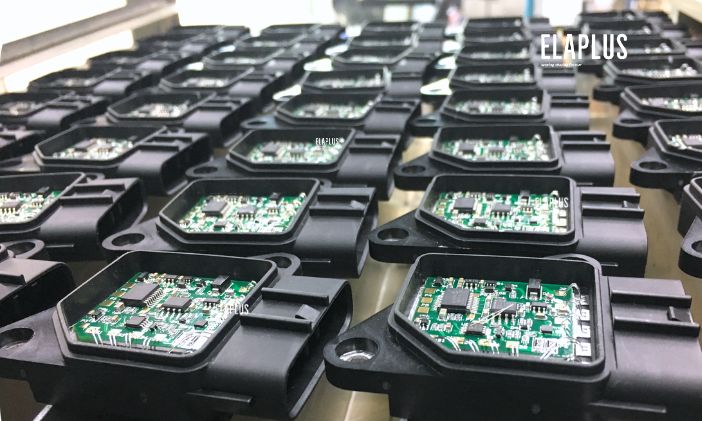
1. High-level Sealing & Protection
Moisture is the top killer of sensor circuits. Even tiny water vapor penetration will cause signal drift, corrosion and short circuit.
2. Excellent Thermal Shock Resistance
Traditional rigid potting compounds easily generate internal stress under temperature cycling. Long-term stress may cause solder joint cracking or encapsulation delamination.
3. Critical Stress Buffering Capacity
The internal MEMS chips and precision resistor networks of sensors are extremely sensitive to mechanical stress. The potting material must possess sufficient flexibility to absorb vibration and impact.
4. Uncompromised Long-Term Reliability
The material must not experience oil bleeding, yellowing or hardening during long-term service; otherwise, sensor signal accuracy and response speed will be directly affected.
SIGEL 1875: Self-Healing Silicone Gel Specially Developed for High-Reliability Sensor Encapsulation
To address the above challenges, ELAPLUS launches SIGEL 1875 transparent two-component self-healing silicone gel. With fundamental innovation in material science, it delivers a systematic encapsulation solution for MAF sensors.
Transparent 1:1 Addition-Cured Formula, Excellent Processability
SIGEL 1875 adopts a classic 1:1 volume mixing ratio with addition curing mechanism. No by-products are released during curing, causing no bubbles or shrinkage. This eliminates concerns about void formation or stress concentration after potting. Its transparent appearance supports visual inspection of potting quality on production lines, greatly reducing process defect rates.
High Elongation & Self-Healing Property Redefine Flexible Protection
After curing, SIGEL 1875 forms a soft elastic body with outstanding high elongation. When subjected to external compression or deformation caused by temperature change, the material can restore its original shape automatically — its unique self-healing capability. For MAF sensors enduring long-term engine vibration, this feature prevents cracks in the encapsulation layer under repeated stress and maintains permanent sealing integrity.
Ultra-Low Oil Bleeding Solves Common Pain Point of Silicone Gel
Oil bleeding is a common drawback of conventional silicone gels. Migrated low-molecular silicone oil not only spoils product appearance but also may contaminate connector contacts or optical windows, resulting in poor contact and signal attenuation.
With optimized molecular structure design and strict process control, SIGEL 1875 achieves ultra-low oil bleeding after curing, together with excellent anti-poisoning performance, ensuring stable sensor operation within its 15-year design lifespan.
Superior Electrical Insulation for High-Voltage Environment
With the popularization of high-voltage platforms in new energy vehicles, the electromagnetic environment around MAF sensors becomes increasingly complex. SIGEL 1875 features outstanding high-temperature electrical insulation, high volume resistivity and excellent dielectric strength, effectively isolating high-voltage interference and forming a reliable insulation barrier for precision signal circuits.
All-Round Environmental Resistance: Aging, Waterproof, Anti-Corrosion & Moisture-Proof
Validated by strict accelerated aging tests, SIGEL 1875 adapts to environments from frigid zones to tropical regions, coastal salt spray to inland dust conditions.
The Si-O bond energy of silicone main chain is much higher than the C-C bond of ordinary organic materials, endowing the material with superior resistance to ozone, UV radiation and chemical corrosion. Combined with a dense cross-linked network structure, it achieves extremely low water vapor permeability and reaches IP67 and above protection level.
Beyond MAF Sensors: Diversified Application Scenarios of SIGEL 1875
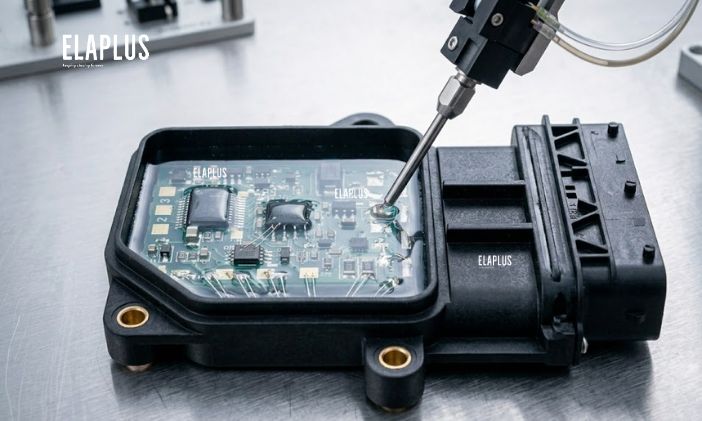
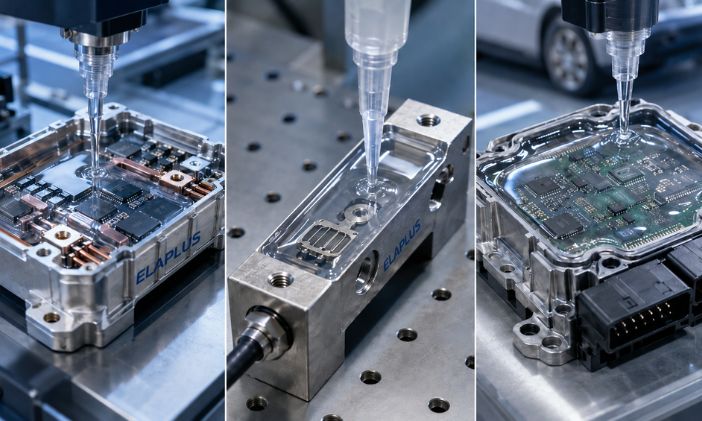
While SIGEL 1875 performs excellently in MAF sensor encapsulation, its technical advantages are also applicable to other high-reliability electronic packaging scenarios:
IGBT & Power Semiconductor Module Encapsulation
In new energy vehicle electric drive systems, IGBT modules operate under high voltage, large current and high temperature. Featuring low-stress property and high insulation strength, SIGEL 1875 is the preferred material for bottom potting and top protection of IGBT modules, effectively buffering thermal cycling stress and extending service life of power modules.
Load cells are highly sensitive to mechanical stress; any extra stress load will be converted directly into measurement error. With ultra-low modulus and high flexibility, SIGEL 1875 provides protection while barely adding mechanical load to sensors, ensuring measurement accuracy unaffected by encapsulation.
Automotive ECU Module Encapsulation
Modern automotive ECUs integrate a large number of precision electronic components, featuring wide operating temperature range and high EMC requirements. SIGEL 1875 provides multi-dimensional protection for ECUs against physical impact, chemical corrosion, moisture ingress and electromagnetic interference.
Waterproof Connector Potting
For connectors working in long-term water immersion or high-humidity environments, SIGEL 1875 delivers excellent adhesion and sealing performance together with aging resistance, ensuring stable electrical connection under harsh working conditions.
Why Choose ELAPLUS?
As a professional supplier of organic polymer adhesives, ELAPLUS has deep expertise in electronic packaging materials for many years. Our products are widely applied in high-end manufacturing fields including automotive, industry, medical treatment and aerospace.
We provide not only materials, but also full-chain technical support from material selection consultation to process optimization.
For MAF sensor potting applications, ELAPLUS recommends a synergistic solution of SIGEL 1875 self-healing silicone gel + SIPA 1807 adhesive silicone gel:
SIGEL 1875 undertakes flexible potting and stress buffering for internal circuits;
SIPA 1807 is responsible for housing structural sealing and bonding.
The combination realizes comprehensive protection from material to structural level.
In electronic manufacturing, material is the cornerstone of performance. A high-quality potting compound is not a cost, but an investment in reliability.
When your MAF sensor needs to maintain accurate measurement for more than ten years in extreme environments; When your IGBT module needs stable high-power output under high temperature and high humidity;When your automotive ECU requires zero-failure operation under vibration and impact —SIGEL 1875 is your trustworthy choice.