——A comprehensive knowledge guide from fundamental principles to industrial applications In modern industrial manufacturing, adhesives are no longer merely auxiliary materials for “sticking things together”, but key materials directly involved in structural load-bearing, performance assurance, and product reliability. Among them, epoxy adhesives are widely used in various fields such as electronics, electrical appliances, automobiles, new energy, machinery manufacturing, and construction due to their high strength, high stability, and high designability.
This article will systematically introduce the basic concepts, performance characteristics, industrial-grade application scenarios of epoxy resin adhesives, as well as the main classifications of high-performance epoxy resin adhesives currently available on the market, to help you establish a complete and clear cognitive system.
- What is epoxy resin adhesive?
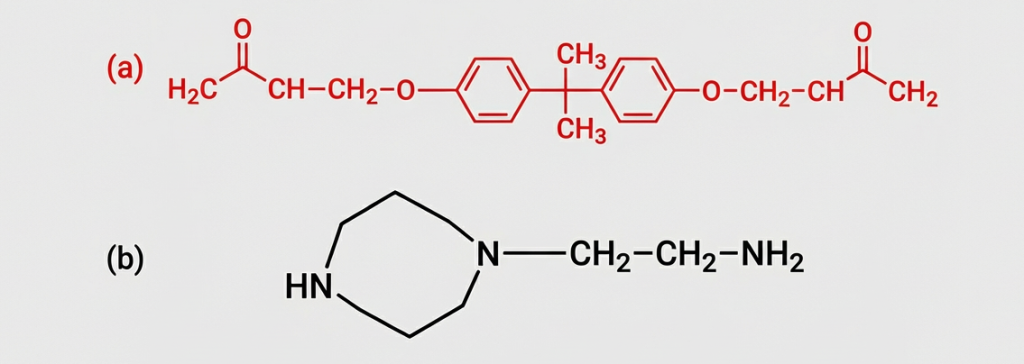
Epoxy resin adhesive is a thermosetting adhesive material primarily composed of epoxy resin, which undergoes a crosslinking reaction upon the addition of a curing agent (hardener). - Basic Chemical Principles: Epoxy resin molecules contain active epoxy groups. Under the influence of curing agents (such as amines, anhydrides, etc.), these groups undergo ring-opening reactions to form a three-dimensional cross-linked network structure. Once this structure is formed, the material will no longer melt or dissolve, exhibiting extremely high mechanical strength and environmental stability.
- Unlike ordinary adhesives such as acrylic adhesive, silicone adhesive, or hot melt adhesive, epoxy adhesive does not rely solely on “surface adhesion”. Instead, it achieves structural bonding through a combination of chemical bonding and mechanical interlocking, thus exhibiting significant advantages in terms of load-bearing capacity, durability, and reliability.
- Definition of industrial epoxy resin adhesive: When epoxy resin adhesive is designed for continuous production, structural load-bearing, harsh environments, or high reliability requirements, it is commonly referred to as industrial epoxy resin adhesive.
This type of product places greater emphasis on:
Performance consistency, long-term reliability, and process adaptability (automation, potting, dispensing, etc.) II. Main performance characteristics of epoxy resin adhesives 1. Extremely high bonding strength Epoxy adhesive can form a strong bond with various substrates such as metal, ceramics, glass, FR-4, engineering plastics, and concrete. It is commonly used to replace traditional connection methods such as screws, riveting, and welding, enabling lightweight and structural integration design.
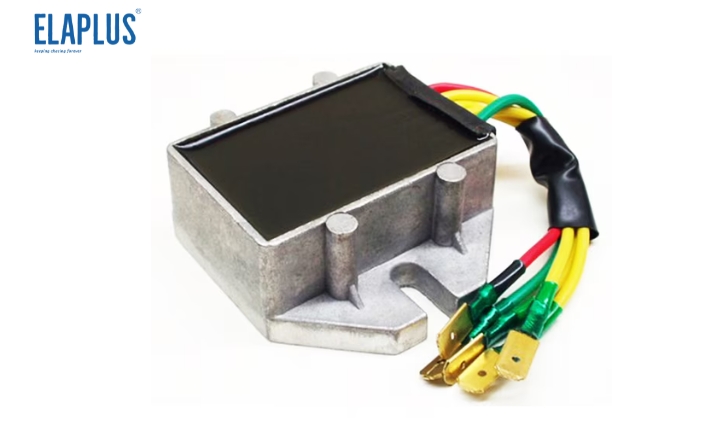
Motor magnet adhesive Motor magnet adhesive 2. Excellent heat resistance and environmental resistance The cured epoxy resin has good thermal stability, and conventional industrial-grade products can operate for long periods at -40℃~120℃. Some high-temperature resistant systems can withstand short-term temperatures of 150℃~200℃ or even higher.
At the same time, it exhibits excellent resistance to water vapor, oil stains, acids, alkalis, and various chemical media.
- Epoxy resin inherently possesses excellent electrical and insulating properties:
High volume resistivity, high breakdown voltage, and low dielectric loss make it widely used in electrical fields such as electronic potting, transformers, sensors, and power modules.
- Highly designable performance: Through formula adjustments, epoxy adhesive can achieve:
High hardness/high toughness balance, high thermal conductivity/insulating type, rapid curing, long operating time, transparency, and filler reinforcement are the core reasons why industrial epoxy adhesives can meet the needs of multiple industries.
- It is important to note that the process requirements are relatively high for epoxy resin adhesive, which is sensitive to:
The surface treatment and curing conditions (temperature, time) of mixed proportion substrates are relatively sensitive, and improper operation may affect the final performance.
III. Typical application scenarios of industrial epoxy resin adhesives 1. Electronic and electrical industry High-voltage encapsulation High-voltage encapsulation PCB board encapsulation and protection Sensor, coil, power module encapsulation LED lighting Waterproof, moisture-proof, shock-resistant High-voltage component insulation and fixation Epoxy adhesive mainly plays the triple roles of insulation, protection, and structural fixation in this field.
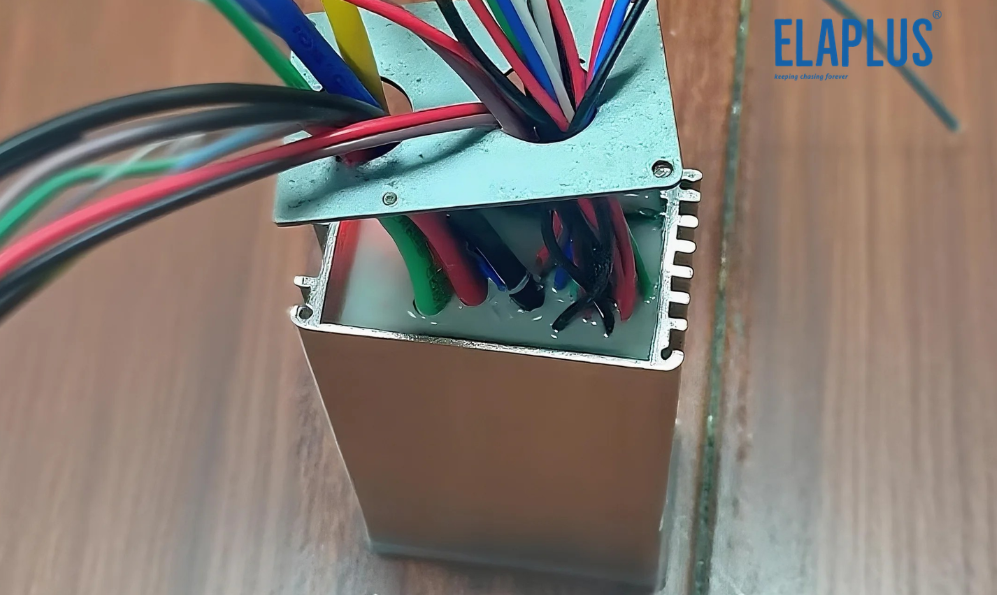
- In the automotive and new energy sectors, wire harness board potting adhesive is used for wire harness board potting, automotive electronic module packaging, power battery and electronic control unit structure bonding, as well as internal potting of charging piles, charging guns, motors, ignition systems, and sensors. With the development of new energy vehicles, the demand for heat-resistant, aging-resistant, and low-stress epoxy adhesives continues to grow.
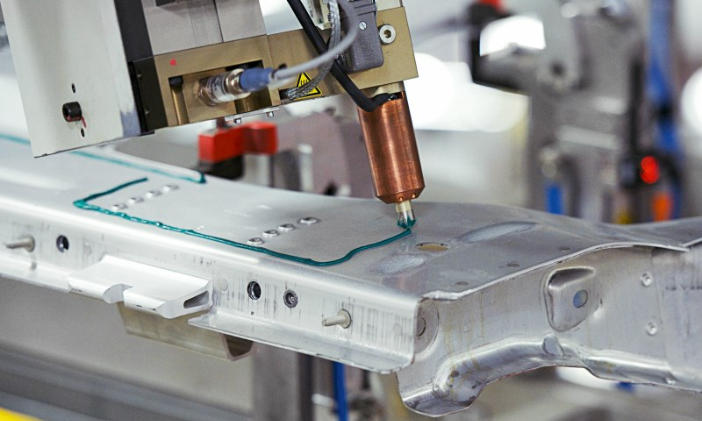
- Industrial equipment and machinery manufacturing, body structure bonding, metal structure bonding, precision component positioning and fixation, mold repair and crack filling, anti-vibration and anti-impact structure reinforcement. In many applications, epoxy adhesive has become an effective supplement or even an alternative to welding.
- Construction and engineering reinforcement: Concrete crack repair, structural reinforcement, and anchoring of floors, stone materials, and ceramic tiles. Its high strength and durability make it particularly suitable for long-term service environments.
IV. Main classification of high-performance epoxy resin adhesives in the market 1. Classification by component form ① Two-component epoxy adhesive (2K/AB adhesive)

Before use, mix it according to the ratio. It can be cured at room temperature or heated for curing, offering a wide range of performance adjustment options. It is widely used. View epoxy potting adhesive ② one-component epoxy adhesive (1K)
Pre-mixed systems require heating for curing, suitable for automated production and high consistency requirements. 2. Classified by function and performance, structural epoxy adhesives: high strength, used for load-bearing and structural connections. View epoxy structural bonding adhesives. Potting epoxy adhesives: good fluidity, used for electronic protection. View epoxy potting adhesives. High-temperature resistant epoxy adhesives: suitable for electrical insulation in engines, ignition systems, etc. Epoxy adhesives with high dielectric properties. Thermal conductive epoxy adhesives: used for electronic heat dissipation. Transparent epoxy adhesives: applications with high optical or appearance requirements. Toughness-modified epoxy adhesives: reduce stress and prevent cracking. 3. Customized classification by application industry. Currently, more and more industrial epoxy adhesives on the market are no longer “general-purpose”, but are targeted at:
Scenario-based formula design is conducted for electronic automotive new energy industrial equipment to match actual working conditions and requirements.
V. Summary: How to correctly understand and choose industrial epoxy resin adhesives?
Epoxy resin adhesive is not “the harder the better” or “the more expensive the better”, but needs to be based on:
Thermal conductive epoxy structural adhesive The selection of thermal conductive epoxy structural adhesive involves considering the usage environment, substrate type, process conditions, reliability, and lifespan requirements.
ELAPLUS – Your Comprehensive Industrial Epoxy Resin Solution Partner ELAPLUS is committed to being a leading provider of industrial material solutions, offering comprehensive service capabilities:
We offer a full range of 1K and 2K epoxy resins, suitable for bonding, potting, encapsulation, and circuit coating.
From manual to fully automated distribution system
Technical consultation, laboratory testing, and on-site support services
Contact ELAPLUS immediately for expert guidance and choose the epoxy resin solution that best suits your production and technical requirements!