Under the wave of new energy vehicles, industrial automation, and intelligent manufacturing, efficient, energy-saving, and miniaturized permanent magnet motors have become the core of technological development. As a key technology, “spliced magnetic steel” is leading a revolution in motor performance. Today, we will delve into the core of splicing magnetic steel – high-performance adhesive. How to use the key process of “bonding” to cut off the root cause of motor “internal friction” and achieve a huge leap in efficiency.
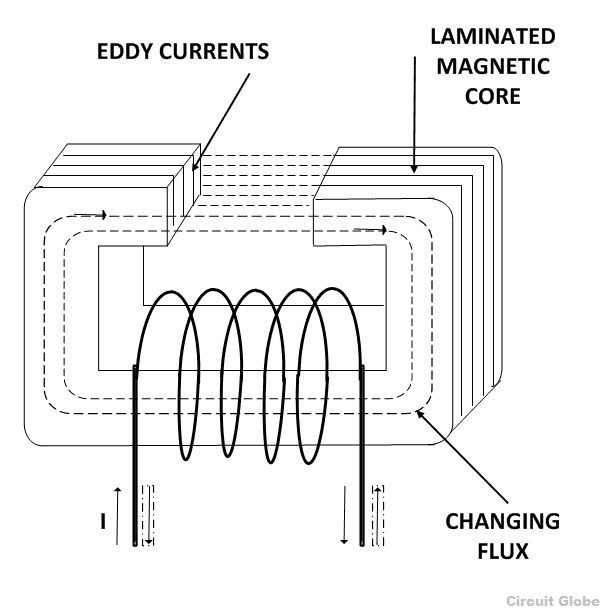
- The culprit of “internal friction” in motors – eddy current loss
What is eddy current?
When the motor is running, the changing magnetic field will induce a closed circular current inside the conductive permanent magnet (such as neodymium iron boron magnet), which is called “eddy current” because it resembles a vortex in water.
Eddy current loss, what has been lost?
When eddy currents flow inside the magnetic steel, a large amount of heat is generated due to resistance, which is useless and consumes the electrical energy originally used to drive the motor.
What impact does’ internal friction ‘have on motors?
The heat generated by eddy currents is a ‘hidden killer’ of motor performance, which can lead to:
The hazards of eddy current losses
Performance degradation: Magnetic steel will undergo irreversible demagnetization at high temperatures, resulting in a decrease in motor torque and power.
Efficiency reduction: Electric energy is converted into useless heat, and motors consume more electricity. For electric vehicles, this means reduced range, while for industrial equipment, it means increased operating costs.
Shortened lifespan: Continuous overheating will accelerate the aging of various components of the motor, leading to a decrease in reliability.
Vortex failure vicious cycle:
electric energy
→
eddy current
→
Magnetic steel heating
→
Weakening of magnetic properties
→
The motor lacks power, consumes electricity, and generates more heat
- The way to break the deadlock: the “combination” of splicing magnetic steel and adhesive
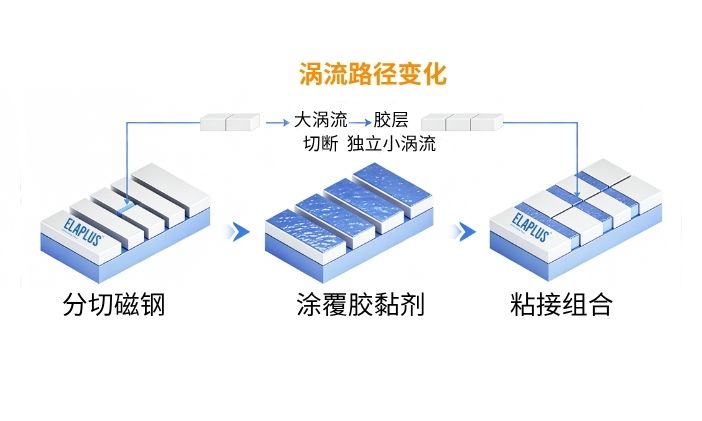
In order to fundamentally solve the eddy current problem, the “spliced magnetic steel” technology has emerged. It divides a whole piece of large magnetic steel into multiple small magnetic tiles, and then re bonds them together with insulating adhesive.
Schematic diagram of spliced magnetic steel structure
The core principle is to use an insulating adhesive layer to “cut off” the path of eddy currents. This allows the originally unobstructed large eddy currents to be divided into many small, independent small eddy currents inside their respective magnetic tiles, greatly reducing the total eddy current losses.
The core role of adhesive in splicing magnetic steel
Excellent insulation: This is the foundation for achieving eddy current “segmentation”. The specialized adhesive has extremely high volume resistivity and dielectric strength, which can effectively isolate each magnetic tile and ensure that the eddy current circuit is completely cut off.
High strength structural bonding: In high-speed operation and complex working conditions, the spliced magnetic steel of the motor must maintain a sturdy whole. High performance adhesives can provide strong shear strength and maintain stable adhesion at high temperatures (such as 180 ℃ or even higher), ensuring long-term structural reliability.
Excellent adaptability to working conditions: Professional adhesives need to adapt to a wide temperature range of -55 ℃ to 220 ℃, while also possessing characteristics such as oil resistance, hydrolysis resistance, and salt spray resistance. They can easily cope with the harsh working environment inside the motor, without corroding the magnetic steel, ensuring stable operation of the motor throughout its entire life cycle.
🔌insulation performance
The volume resistivity can reach over 10 ¹⁴Ω· cm
💪high-intensity
The shear strength can reach 20-40 MPa
🌡️high temperature resistance
The working temperature can reach over 180 ° C
⏱️Process adaptation
Support manual to fully automated production lines
Adhesive plays a crucial role in this process:
Excellent insulation: This is the foundation for achieving eddy current “segmentation”. The specialized adhesive has extremely high volume resistivity and dielectric strength, which can effectively isolate each magnetic tile and ensure that the eddy current circuit is completely cut off.
High strength structural bonding: In high-speed operation and complex working conditions, the spliced magnetic steel of the motor must maintain a sturdy whole. High performance adhesives can provide strong shear strength and maintain stable adhesion at high temperatures (such as 180 ℃ or even higher), ensuring long-term structural reliability.
Excellent adaptability to working conditions: Professional adhesives need to adapt to a wide temperature range of -55 ℃ to 220 ℃, while also possessing characteristics such as oil resistance, hydrolysis resistance, and salt spray resistance. They can easily cope with the harsh working environment inside the motor, without corroding the magnetic steel, ensuring stable operation of the motor throughout its entire life cycle.
- Elaplus Splicing Magnetic Steel Adhesive Solution
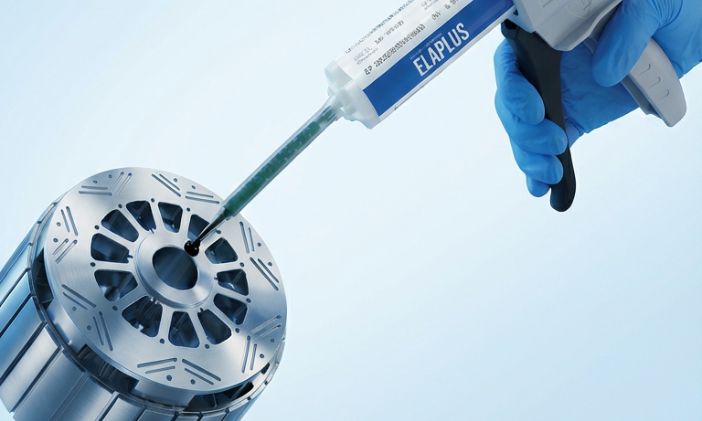
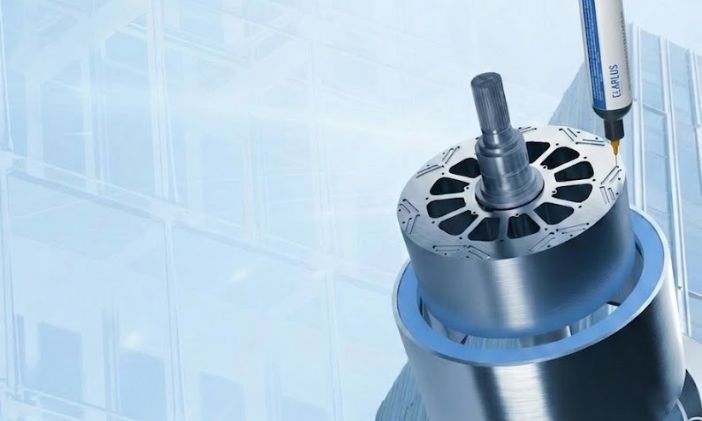
Elaplus provides a range of high-performance epoxy adhesive products that have been validated in the market to meet the stringent requirements of splicing magnetic steel, providing solid support for efficient permanent magnet motors.
⭐ Main recommendation: EP 2029A/B high-temperature resistant two-component epoxy structural adhesive
Splicing magnetic steel bonding
A high-performance ‘warrior’ designed specifically for motor magnet/tile bonding.
High and low temperature resistance: Operating temperature range of -50 ℃~180 ℃, able to handle temperature fluctuations inside the motor with ease.
Excellent strength: The bonding strength to steel can reach 240 Kgf/cm ² (approximately 23.5 MPa), and it can maintain excellent mechanical properties at different temperatures.
Strong insulation: With a volume resistivity of up to 5.20E+14 Ω· cm and a dielectric strength of 22 kV/mm, it perfectly achieves a “copper wall and iron wall” barrier against eddy currents.
Reliability certification: Through rigorous wet heat aging and high and low temperature impact cycle testing, it ensures long-term reliability under extreme working conditions.
⭐ Process optimization: EP 1766 single component epoxy adhesive
Ideal choice for pursuing process convenience and automated production line design.
Single component design: No need for mixing, simplifies the production process, and improves production efficiency.
Medium temperature rapid curing: It only takes 20 minutes to cure at 120 ℃, with a faster pace.
Balanced performance: With an excellent volume resistivity of 1.3 × 10 ¹⁵Ω· cm and a steel to steel shear strength of 18 MPa, it achieves an excellent balance between performance and process efficiency.
⭐ Innovative process: EPUV 2085 UV delayed curing epoxy adhesive
A revolutionary solution provided for complex structures and precise positioning assembly.
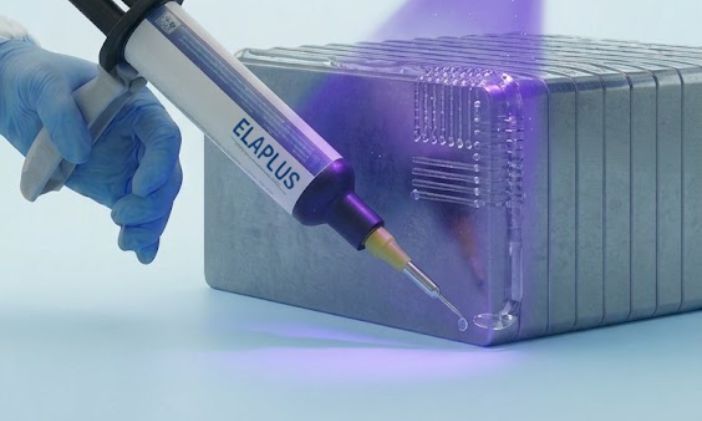
Light controlled curing: After being activated by UV light, the adhesive does not immediately cure, but provides a “open operation time” of up to 90 seconds, making it easy for operators to perform precise alignment and bonding after light exposure.
Process flexibility: It solves the problem of traditional UV glue being unable to cure opaque materials or “shadow areas”, providing unprecedented freedom for splicing process design.
Conclusion
Choosing the right adhesive is a decisive step in leveraging the advantages of splicing magnetic steel and creating high-performance motors. It is not only a simple ‘bonding’, but also an ’empowerment’ of motor efficiency, reliability, and lifespan.

