In power batteries, energy storage batteries, and various lithium battery modules, the issue of cell fixation and potting is no longer a matter of “whether there is any”, but rather a matter of choosing what material to use and how to choose it.
The appropriate potting material not only determines the structural reliability, but also directly affects the safety, stability, and service life of the battery system.
- Why must batteries be fixedly potted?
In actual operating conditions, the battery cell faces the following challenges over the long term:
🔋 Vibration and Shock: Mechanical Stress during Transportation, Running, and Start-Stop Processes 🔥 Thermal Cycling Stress: Repeated Temperature Rise and Drop during Charging and Discharging ⚡ Electrical Safety Risks: Extremely High Insulation Performance Requirements in High-Voltage Environments 🌧️ Environmental Erosion: Long-term Effects of Moisture, Dust, and Condensate Water If the battery cells lack effective fixation and protection, they are prone to:
Loose structure, fatigue of solder joints, decreased insulation performance, potential short-circuit hazards, noise and resonance issues, and significantly shortened service life👉 The core value of cell fixation and potting lies in providing long-term stable “second-layer protection” for cells in terms of structure, electrical, and environmental aspects.
II. Key requirements for adhesive used in cell fixation and potting
For cell application scenarios, potting materials typically need to meet the following requirements simultaneously:
– Good fluidity and filling performance fully coat the cells and gaps, avoiding voids
– Moderate flexibility to buffer vibrations and accommodate thermal expansion and contraction, avoiding stress concentration
– Excellent electrical insulation performance enhances the overall electrical safety level of the package
– The flame retardant and temperature resistance capabilities meet the long-term reliable operation requirements of the battery system
– Lightweight and noise reduction: Reduce the weight of the system while lowering the operating noise
III. Recommended Product: SIPA 1850 (7#) A/B Potting Silicone For cell fixation and potting scenarios, SIPA 1850 (7#) two-component potting silicone is a mature solution that balances safety, processability, and reliability.
▶ Basic product information Type: A/B two-component potting silicone Mixing ratio: 1:1 (simple operation, suitable for automated dispensing) Viscosity: 2000 ± 300 mPa·s Flame retardant grade: HBRTI Long-term temperature resistance: 150 ℃ ▶ Key performance after curing Hardness: Shore A 30 (flexible cushioning) Shore 00 75 ± 10 (low modulus, low stress) Density: 0.71 (significant lightweight advantage) Noise absorption effect: excellent IV. Application advantages of SIPA 1850 in cell fixation and potting ✅ Stable fixation, low stress release The low modulus silicone system effectively absorbs vibration and impact, avoiding rigid pulling on the cell casing and solder joints.
✅ Excellent insulation, enhancing safety by forming a complete and continuous insulating protective layer, reducing the risk of leakage and short circuit, suitable for high-voltage battery systems.
✅ Flame-retardant and heat-resistant, with long-term reliability and an RTI of 150℃, it is suitable for long-term battery operation environments. Its flame-retardant properties provide fundamental protection for system safety.
✅ Noise reduction and shock absorption, enhancing the overall package quality with good noise absorption ability, effectively suppressing resonance and abnormal noise during the operation of the battery cell.
✅ Low-density design facilitates lightweighting, reducing the overall weight of the system while ensuring protective performance, making it particularly suitable for power and energy storage applications.
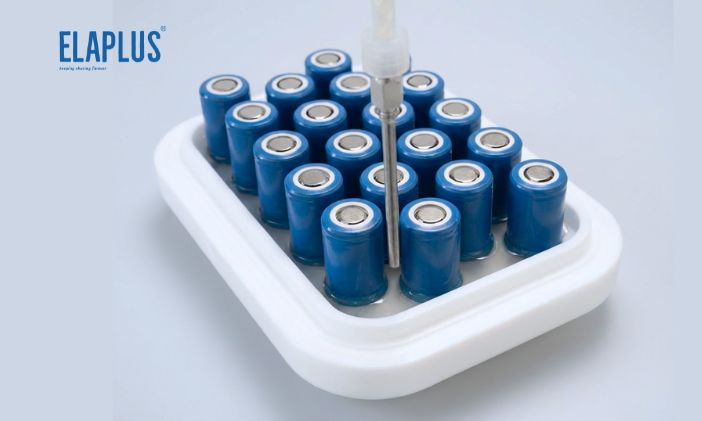
- Typical application scenarios 🔹 Fixed potting of power battery cells 🔹 Potting of energy storage battery modules 🔹 Industrial and commercial energy storage systems 🔹 Battery structure with high requirements for shock absorption and noise reduction The fixed potting of battery cells is not simply “filling with glue”, but a systematic engineering involving material properties, structural design, and reliability.
SIPA 1850 (7#) A/B potting silicone, characterized by its flexibility, low stress, excellent insulation, flame retardancy, and temperature resistance, provides stable and durable protection for the battery cell, helping the battery system achieve longer lifespan and higher safety level.