Researchers at Columbia University have recently made a breakthrough in the field of optoelectronics, successfully fabricating the smallest integrated photonic circuit to date and achieving high-performance stable operation over a wide wavelength range for the first time.
Researchers liken this achievement to replacing vacuum tubes with semiconductor transistors, with potential impacts significant enough to reshape optical communication and optical signal processing systems.
However, as PIC continues to evolve towards smaller sizes, higher integration, and more complex functions, a key aspect that has long been underestimated but determines system reliability is gradually emerging:
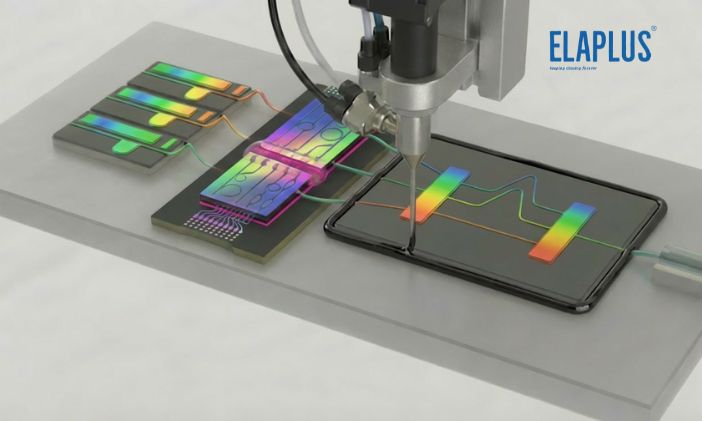
Packaging and bonding materials for photonic integrated circuits.
- PIC packaging: Unlike electronic ICs, which are the “invisible core” determining the success or failure of a system, photonic integrated circuits utilize photons rather than electrons. Their packaging not only needs to “fix the devices” but also requires precise control over the propagation behavior of light.
In actual mass production, the challenges faced by PIC packaging mainly focus on the following aspects:
Mode Field Matching (模场匹配) sub-micron high-precision alignment and assembly technology for high-speed, repeatable automated packaging processes, which can reliably operate under harsh conditions such as high temperature, high humidity, and reflow soldering, has a very high cost proportion. According to the report “Photonics Packaging 2023” by Yole Développement
In photonic integrated systems, over 70% of the overall cost comes from packaging and assembly processes
This means that packaging materials, especially adhesives, are no longer “auxiliary materials” but rather system-level key materials.
II. Why are adhesives for PIC packaging so demanding?
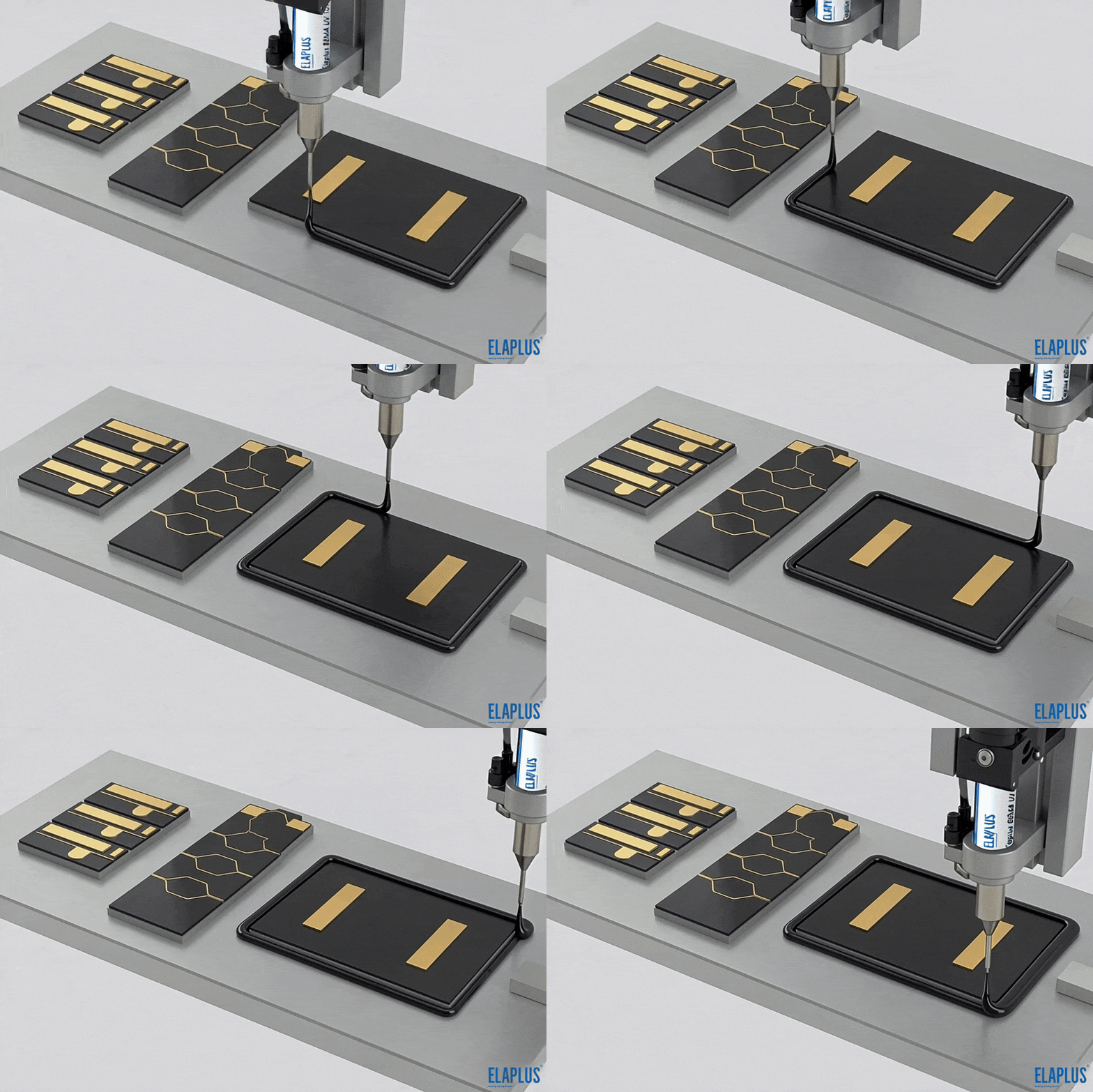
In the PIC package, the adhesive plays multiple roles simultaneously:
1️⃣ Mechanical fixation + optical stabilization: Wafers, chips, optical fibers, lenses, and waveguide arrays require long-term submicron-level positional stability. The shrinkage rate, modulus, and stress release capability of the adhesive directly affect the optical coupling efficiency. 2️⃣ Thermal-moisture-stress multiphysics coupling: Reflow soldering, high-temperature storage (HTS), and high-humidity high-temperature (HAST) conditions can lead to optical path drift or failure due to material water absorption and CTE mismatch. 3️⃣ Process window determines mass production yield: UV/thermal curing speed, dispensing fluidity, thixotropy, dimensional stability and consistency after curing. 📌 In high-density PIC packaging, adhesives are often the “last mile that determines yield.”.
III. ELAPLUS: A PIC Packaging Adhesive Solution Focused on “Reliability” Centered around Photonic Integrated Circuit (PIC) Applications, ELAPLUS specializes in the development of “highly reliable optoelectronic packaging adhesive systems” with a single core objective:
Under the most stringent packaging conditions, it still maintains long-term stability in optical, mechanical, and electrical performance.
🔹 Even under the following conditions: reflow soldering process with high humidity storage, thermal cycling, thermal and cold impact, and long-term aging testing, ELAPLUS adhesive can still maintain stable bonding strength and dimensional reliability, providing material support for the large-scale application of PIC.
IV. Typical adhesive solution for ELAPLUS in PIC packaging
▶ UV curing series (high-precision rapid encapsulation) is suitable for the pre-fixation of metal and glass.
Low shrinkage rate.
Good bonding effect.
Low water absorption rate, suitable for device reinforcement and moisture protection.
It has passed reliability tests such as double 85 temperature test and high and low temperature cycling test.
Typical product
UV 1017(Shore D 50)UV 1018(Shore A 80)
Instant curing, suitable for automated production lines with low shrinkage rate, facilitating precise alignment in the mold field. Widely used in fiber-chip, microlens assembly and fixation. ▶ Medium and high temperature curing series
Typical product
EP 1729 Epoxy Adhesive (High-Temperature Curing)
A typical product suitable for PIC packaging with high thermal stability requirements, maintaining long-term reliability in complex packaging structures
EP 1722-2 black epoxy resin adhesive (low-temperature curing)
Suitable for structural protection of optoelectronic devices, with good bonding effect on plastic/stainless steel.
Low water absorption rate, suitable for device reinforcement and moisture protection.
It has passed reliability tests such as double 85, high and low temperature cycling.
The two-component series, once mixed, boasts a long lifespan and is easy to operate. Fifthly, from “functionality” to “long-term reliability”, adhesives are reshaping the PIC packaging logic. As PIC evolves towards higher integration, smaller size, and more complex functions, packaging is no longer a simple “back-end process”, but rather:
The core engineering system that determines optical performance, reliability, and commercial viability.
And adhesives are at the critical node of this system.
📌 Choosing the right glue is not just about solving bonding problems, but also about securing the future of photonic systems.